October 2026
Beyond the Sum of Parts: Integrating Inner and Outer Transformation in Higher Education
8. October 2026, lecture, University of Iceland, Reykjavik
How can higher education prepare students not only to understand sustainability challenges, but to become capable of contributing to transformative change? This talk presents a comparative analysis of educational competency frameworks across seven European universities, exploring how they address inner capacities alongside technical and professional competencies.
Drawing on the Inner-Outer Transformation Model and the Education Tree, the study examines how frameworks such as the Inner Development Goals (IDG) can help bridge cognitive, emotional, and relational learning. The findings highlight the importance of experiential learning, vertical development, psychosocially safe learning environments, and process-based forms of assessment.
The talk discusses how inner development can be integrated into the core of higher education rather than treated as an additional or separate module—and how this integration can support students in becoming transformative change agents for sustainability.
Lars Rademacher is Professor of Corporate and Sustainability Communication at Darmstadt University of Applied Sciences and heads its Doctoral Centre for Sustainability Sciences. His research spans communication ethics, corporate responsibility, and the role of communication in social and ecological change. He co-edited CSR Communication in the Media (2023) and Nachhaltigkeit in der Medienkommunikation (2025). His recent publications examine situational crisis communication theory and how transformative learning can prepare communication professionals (both 2026).
100 years Eugene Tovio Gendlin
1.-4. October 2026,ÖGwG congress, Vienna, Austria
Inwards – Onwards – Outwards
To mark the 100th anniversary of Eugene T. Gendlin’s birth, the Austrian Society for Scientific, Client-Centered Psychotherapy and Person-Centered Counseling (ÖGwG) hosted a “somewhat different” ÖGWG Week: A conference that created safe relational spaces for conveying content; spaces where genuine, embodied encounters were possible, where the inner and the outer, Focusing and Encounter—or, more generally, the relationship with oneself and the relationship with others—could come together.
Our partner, Professor Akira Ikemi, taught one of the master classes. He also led an Embodied Dialogue with Dr. Leslie Ellis. During this session, the speakers did not merely talk about something, but above all, with one another; they engaged in genuine listening and attunement to one another; they explored what resonance the other’s words triggered and how they intersected with their own implicit experience.
During the panel discussion, Akira Ikemi, as one of the eyewitnesses, recalled encounters with Eugene Tovio Gendlin, described Gendlin’s influence on his own work, and discussed future perspectives, including the idea of understanding “experiencing” as a form of “literacy”—in memory of Mary Hendricks as well.
Monika Lindner guided as master of ceremony through these four days of experiential encounters. Part of the program was live streamed, recordings will be available soon at the congress webpage.
September 2026
Minisophy of Things: Exploring Lived Experience through Everyday Objects
9. – 11. September 2026, Hugarflug, Iceland University of the Arts, Reykjavik, Reykjavik
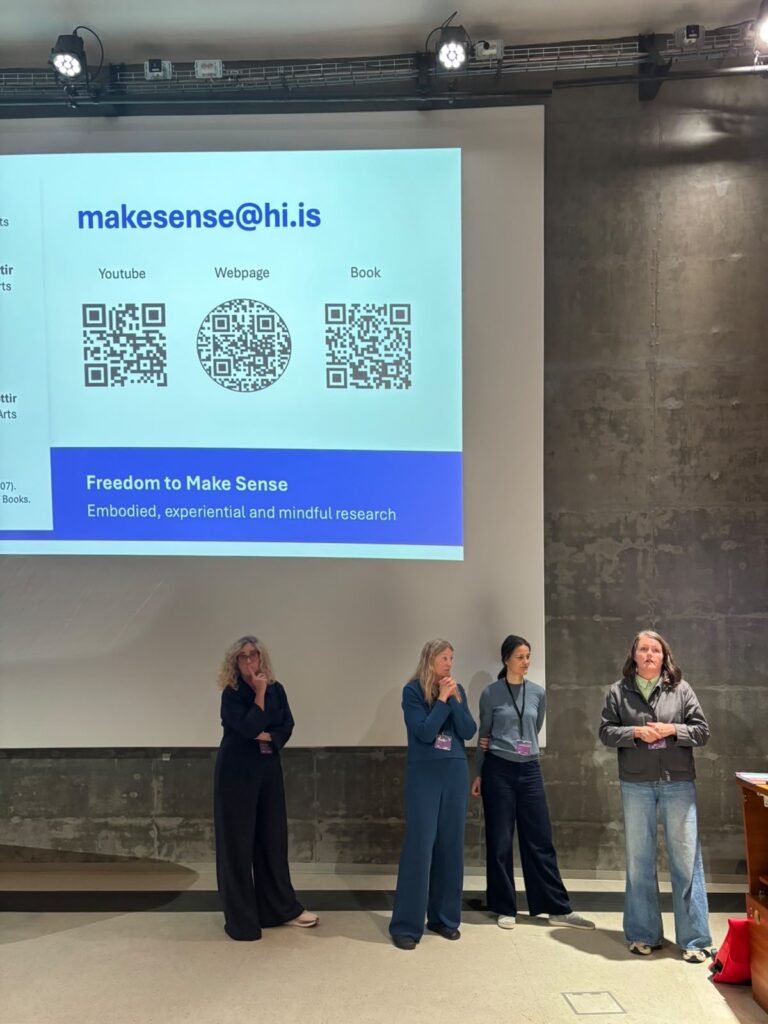
Sigríður Þorgeirsdóttir, Professor of Philosophy at the University of Iceland and one of the PIs of the Freedom to Make Sense research project, presented at Hugarflug, a conference at the Iceland University of the Arts. This year’s theme, “Sensing the World,” resonates strongly with the Make Sense project’s interest in embodied ways of knowing and experiencing the world.
Together with Katrín Ólína Pétursdóttir, designer, researcher and Dean of the Department of Design at the Iceland University of the Arts, Sigríður presented their project:
Minisophy of Things: The Science of Lived Experience in the Everyday World
Our everyday world is shaped through encounters with ordinary things: a spoon, a curtain, a glass, a door handle. We touch them, use them and move with them, yet rarely pause to consider how they shape our lived experience.
In Minisophy of Things, Sigríður and Katrín explore how everyday objects participate in human experience. The project draws on the micro-phenomenological interview methods developed by Claire Petitmengin to investigate how objects appear in lived experience through touch, weight, resistance, movement and memory. Combining self-interviews, drawings and interviews with participants, the research explores shared patterns in how people experience everyday objects.
Presented as a dialogue between design practice and philosophical reflection, the project invites us to consider ordinary objects not merely as tools, but as active participants in the experiential fabric of everyday life.
The talk was moderated by Guðbjörg R. Jóhannesdóttir, Professor of Philosophy at the University of Iceland and also one of the PIs of the Freedom to Make Sense project.
Education – making sense?
9. – 11. September 2026, Hugarflug, Iceland University of the Arts, Reykjavik
The annual conference on artistic research at the Iceland University of the Arts is a forum for open, scholarly, and critical discussions about art, design, and architecture (Hugarflug). In its fifteenth edition, the conference, under the theme “Sensing the World,” focused on perception and the question of how we deal with our own perceptions and the world around us. It is evident that perception is never uniform but rather complex, shaped by context, and influences our communication.
Members of the Freedom to Make Sense project contributed two Workshops. Central to our philosophical foundation and our projects is the realization that, through a “felt sense,” we can connect with the complex specificity of a situation that goes beyond the conventional understanding of perception.
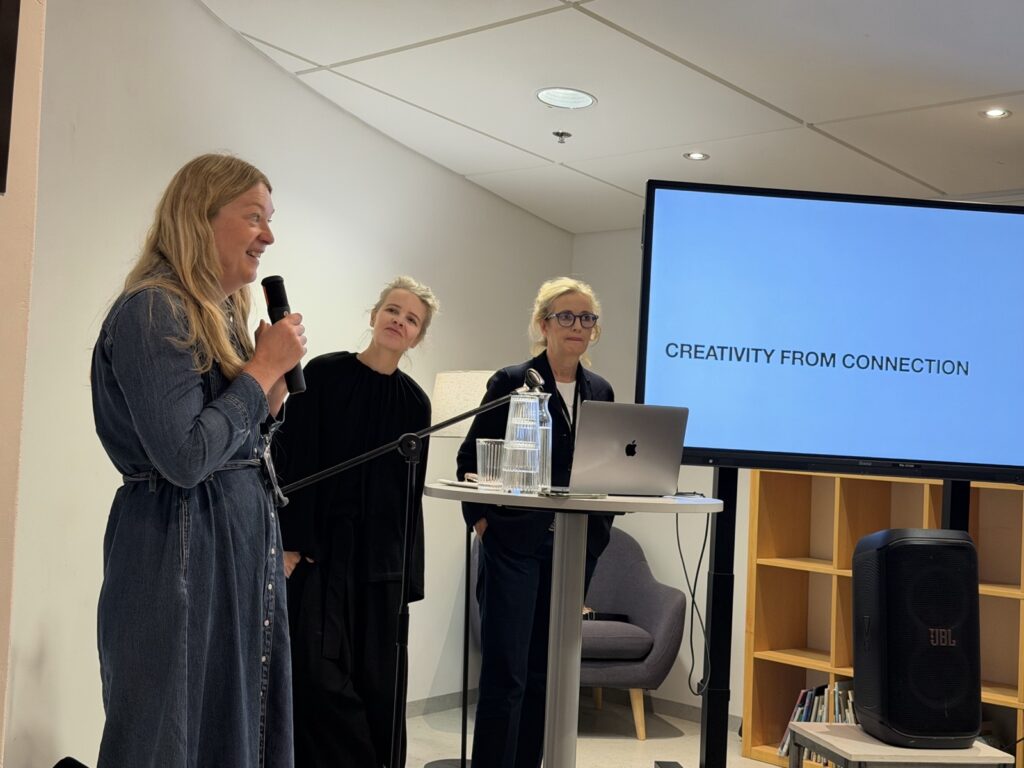
Guðbjörg Rannveig Jóhannesdóttir, Kristín Valsdóttir, Monika C. Lindner, and Gunndís Ýr Finnbogadóttir invited in their workshop „Education – making sense?“ to gain an impression, through small exercises, of how innovative methods of embodied inquiry can be applied in educational contexts. The discussion centered on the project’s goal of introducing and integrating these methods into higher and secondary education at a time of a crisis of meaning in research and teaching—a goal that calls for transformative education that reestablishes a connection to the vibrant richness of lived experience, natural environments, and embodied sources of thought.
Instensive four-day workshop on Gendlin‘s process model in Germany
DFI Summer School, Germany
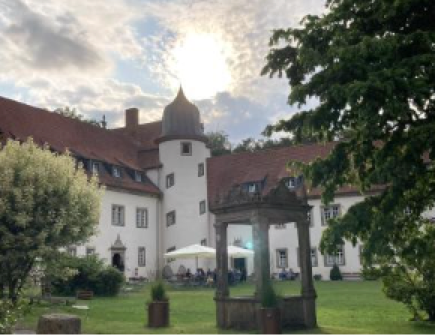
Donata Schoeller taught an intensive four-day workshop on Gendlin’s A Process Model as part of the 45th Summer School of the Deutsches Focusing Institut (DFI) at Schloss Buchenau.
Twenty participants from diverse academic and professional backgrounds — including politics, philosophy, medicine, therapy, and business — engaged deeply with the basic model of Gendlin’s process thinking. A distinctive feature of the workshop was the use of embodied thinking practices alongside reading and discussion.
Through simple prompts inspired by the text itself, participants were invited to draw on lived experience to probe, apply, and challenge the conceptual framework of Gendlin’s major work, exploring its relevance across existential, professional, and transdisciplinary layers of understanding.
We are so happy to see our Freedom to Make Sense community continuing to grow and thrive across disciplines, places, and plural environments.
July 2026
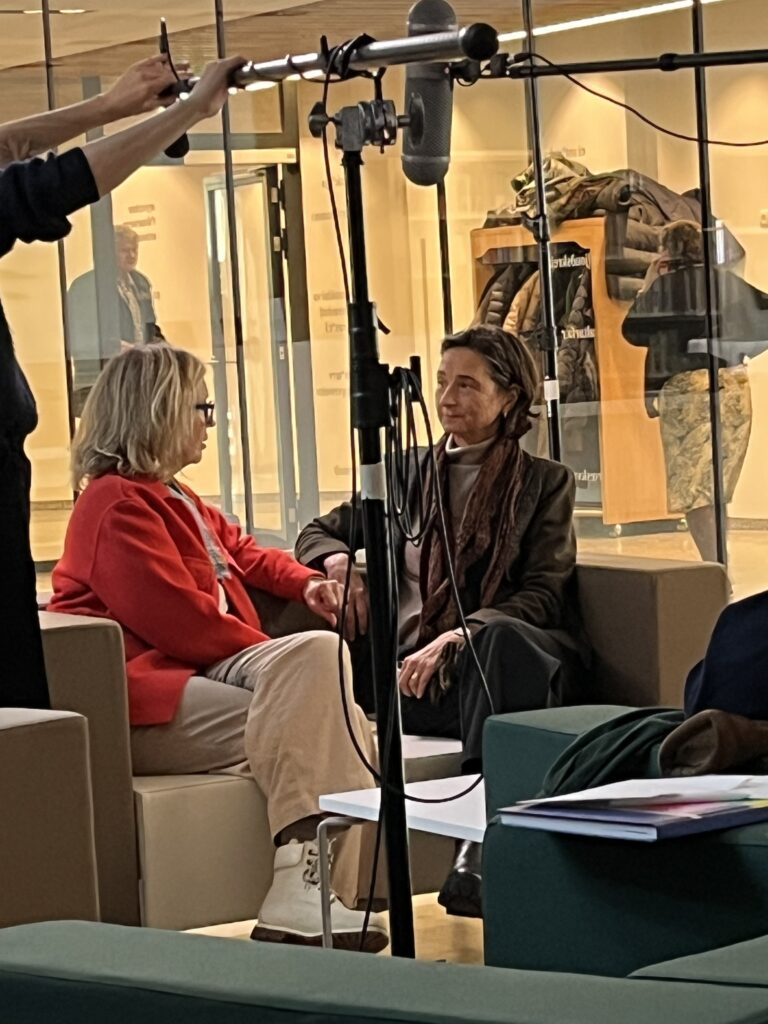
New Short Documentary Introduces Methods of Embodied Critical Thinking
Reykjavik, Iceland
Where do genuinely new ideas come from? They rarely emerge from information alone. Sometimes they begin with a pause, a question that lingers, a walk in the woods, an unexpected conversation, or a vague bodily sense that something more is waiting to become thinkable. What if higher education paid more attention to these moments—not as private intuitions, but as an essential part of rigorous inquiry?
Our new documentary, Methods of Embodied Critical Thinking, offers a first introduction to the international Freedom to Make Sense research project and the educational practices it has been developing over the past six years. Beginning at the University of Iceland and growing into a collaboration involving almost 30 universities, the project explores a simple yet far-reaching question: if thinking is fundamentally embodied, how can we learn to cultivate embodied ways of thinking?
The film introduces the Freedom to Make Sense research and training programme as a living laboratory in which researchers, educators, and students explore practices such as Focusing, Thinking at the Edge, micro-phenomenology, environmental immersion, artistic inquiry, and mindfulness-based approaches. Together, they are investigating how these methods can enrich research, learning, teaching, and collaborative inquiry in higher education. Through interviews with members of the project, the documentary offers a glimpse into this ongoing exploration and into the ways embodied practices can reconnect conceptual inquiry with lived experience.
As artificial intelligence reshapes education and access to knowledge, the question of how we cultivate our distinctly human capacities becomes increasingly important. Rather than offering answers, this short documentary invites viewers to explore one possible direction: embodied and experiential practices that support independent thinking, meaning-making, creativity, and understanding across differences.
Donata Schoeller Appointed Extraordinary Professor at the University of Koblenz
Koblenz, Germany
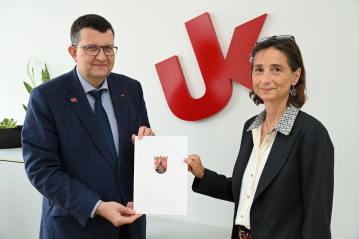
We are delighted to congratulate Dr. Donata Schoeller on her appointment as Extraordinary Professor (außerplanmäßige Professorin) at the Institute of Philosophy at the University of Koblenz.
The appointment recognizes her pioneering contributions to the emerging field of embodied critical thinking and her longstanding commitment to renewing philosophy, research, and higher education.
The University of Koblenz highlights Donata Schoeller’s work as part of the broader turn toward embodiment in contemporary philosophy and cognitive science. While research increasingly recognizes that thinking is fundamentally embodied and shaped by lived experience, her work asks the next question: How can these insights be translated into educational practice?
This question has also been at the heart of the Freedom to Make Sense research project and the Training in Embodied Critical Thinking and Understanding (TECTU) programme, jointly initiated by Donata Schoeller and collaborators in Iceland in collaboration with the University of Koblenz and an international network of researchers. The projects have developed and investigated practices that cultivate embodied, experiential, critical, and creative thinking. Over the past six years, TECTU has served as a living laboratory in which philosophers, cognitive scientists, psychologists, educators, artists, and researchers have explored methods such as Focusing, Thinking at the Edge, micro-phenomenology, environmental immersion, artistic inquiry, and mindfulness-based practices.
Today, these methods are being further developed through the Freedom to Make Sense project at the University of Iceland in collaboration with an expanding international network. As artificial intelligence transforms education and research, the project explores how embodied thinking practices can help students and researchers cultivate deeper understanding, independent thinking, creativity, and dialogue across differences. Donata Schoeller’s appointment is therefore not only a recognition of an individual academic career, but also of a growing international movement that is bringing embodied and experiential approaches into the heart of higher education.
June 2026
International Conference on Hope and Trust in Times of Crisis
June 22, Yerevan, Armenia
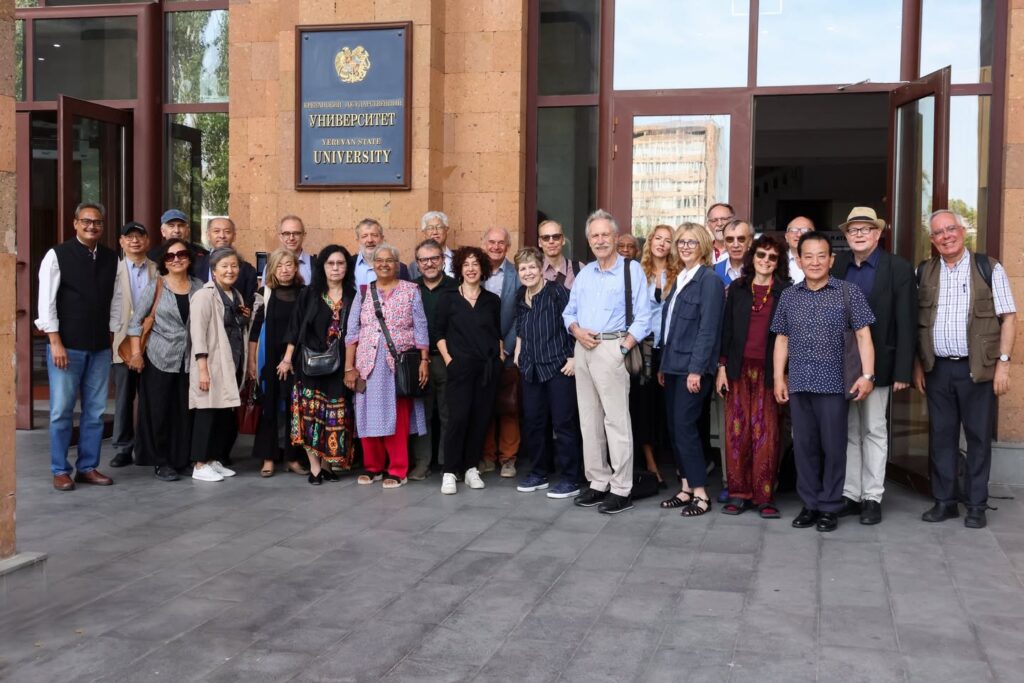
On 22 June 2026, Sigríður Þorgeirsdóttir gave a lecture at the International Conference on the Theme of Hope & Trust in Times of Crisis, held at the American University of Armenia (AUA) in Yerevan.
The conference was organized by the AUA Center for Ethics in Public Affairs (ETICA) in association with the International Federation of Philosophical Societies (FISP), the Armenian Philosophical Academy, and Yerevan State University (YSU). It brought together leading philosophers and scholars from around the world to discuss the role of hope and trust in responding to contemporary social and political crises.
Sigríður’s lecture was entitled „From Trust as Foundation to Trust as Process: Trust in Malecentric Philosophy, Feminist Care Ethics, and Philosophies of Recognition.“ In her presentation, she examined competing philosophical conceptions of trust and argued for understanding trust not as a fixed foundation but as an ongoing process that is cultivated through recognition, dialogue, and embodied interaction.
The conference was attended by Armenia’s First Lady, Anna Hakobyan, who later shared this video from the event on social media. https://fb.watch/I4Sd4LrwSt/
In connection with the conference, Sigríður also participated in the annual meeting of International Federation of Philosophical Societies (FISP), the global organization representing philosophical societies. She has served on the FISP Steering Committee for more than a decade and chaired its Committee on Gender Issues from its establishment in 2015 until 2025.
Symposium
30 years Forum
June 12-13, Vienna, Austria
Under the title ‘Openness and Diversity in Transition: The Person-Centred Approach in Complex Times’, the Forum celebrated its 30th anniversary. It is a training network for ‘Person-Centred Psychotherapy’ in Austria, committed to the Person-Centred Approach developed by Carl R. Rogers which also formed an important context for Gendlin’s philosophical and empirical work.
Monika Lindern was invited to lead a workshop entitled “Focusing: Encountering Complexity with Openness”. This was a focused experiential space that offered a brief insight into the premise of the “Freedom to Make Sense” project: the freedom to participate in shaping meaning.
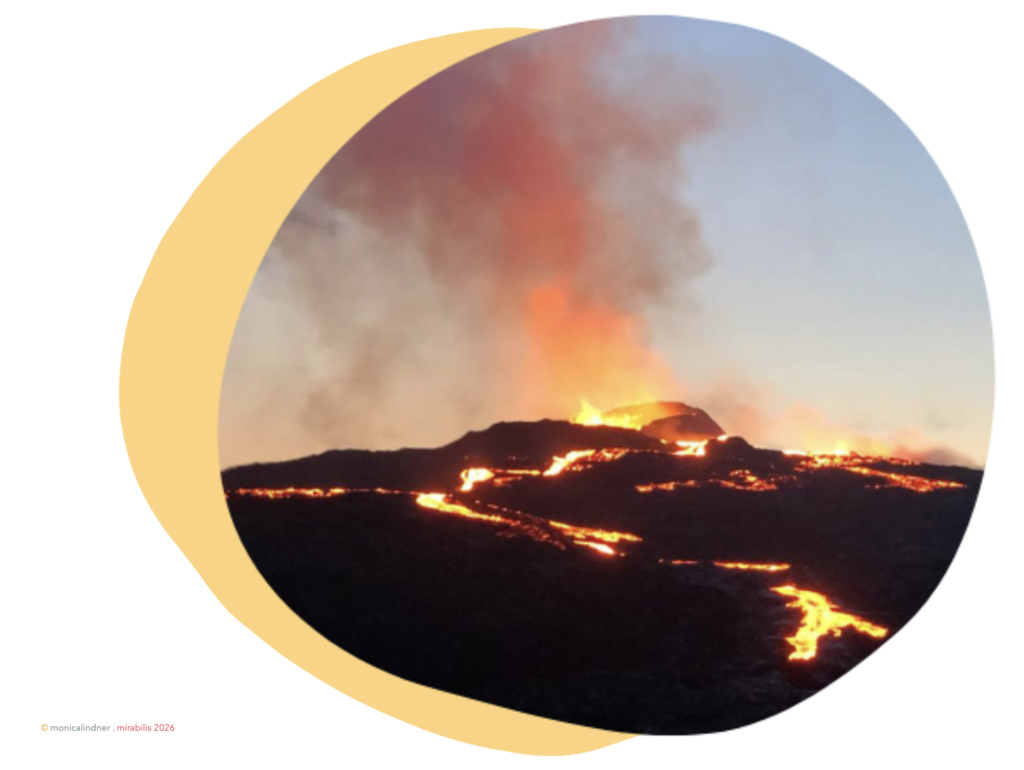
On the one hand, participants were guided – in the spirit of ‘reflective care’ – to connect with a safe place (both inner and shaped by experience). On the other hand, they were able to connect very directly with a ‘Kvika’ (magma) – a pressing, burning, relevant concern that is still difficult to put into words, yet which relates to the complexity of their current situation.
The event brought to life how, on the basis of the person-centred approach vibrant and warm communities can form; communities which, in their field as therapists, support others in facing the challenges of our time by repeatedly turning their attention together to their own complexity and interconnectedness ‘in all of this’.
Conference website: https://www.forum-symposium.at/forum2026/
Embodiment in Education
Second international Conference on Embodied Education
June 8-11, Copenhagen, Denmark
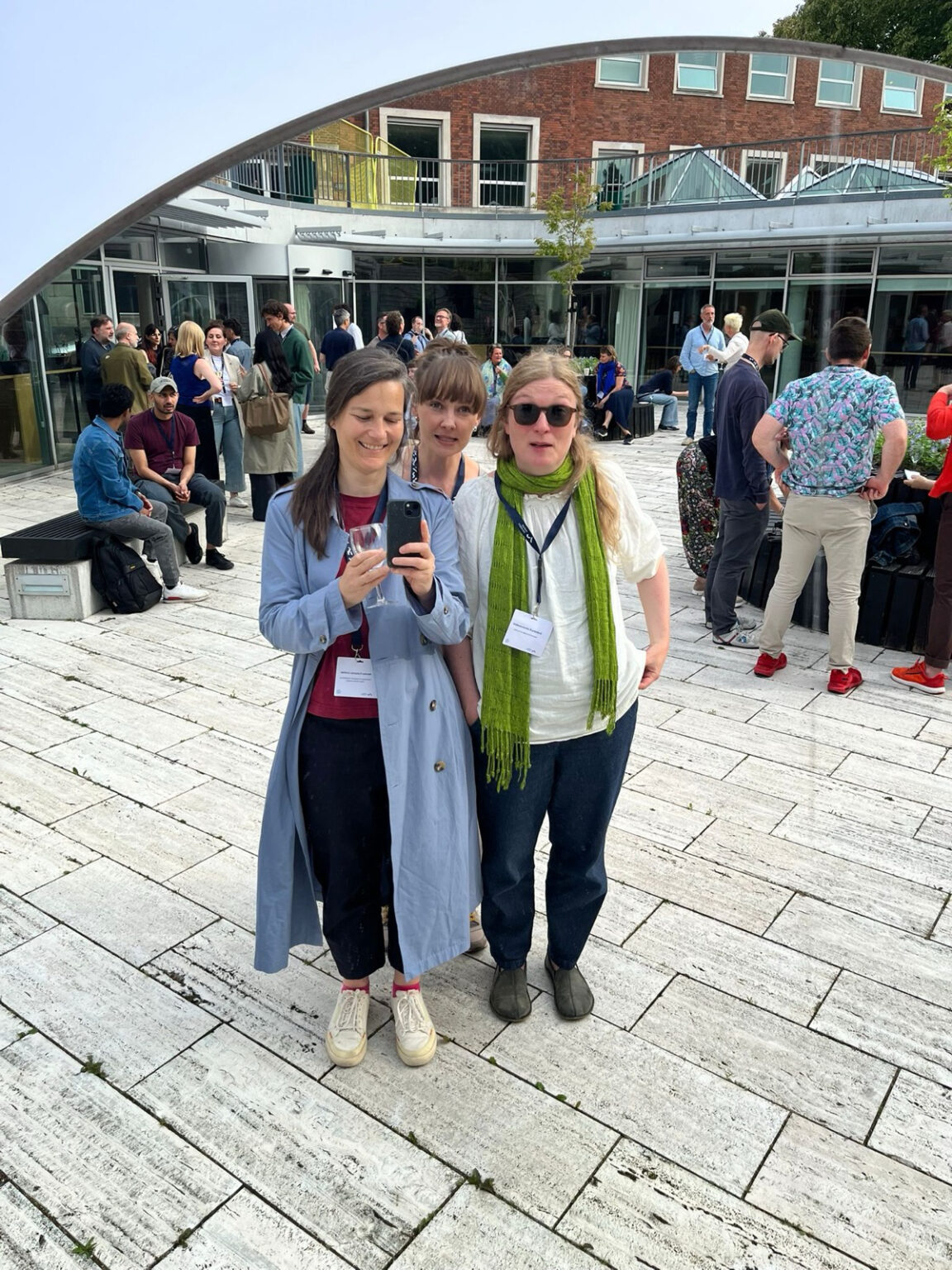
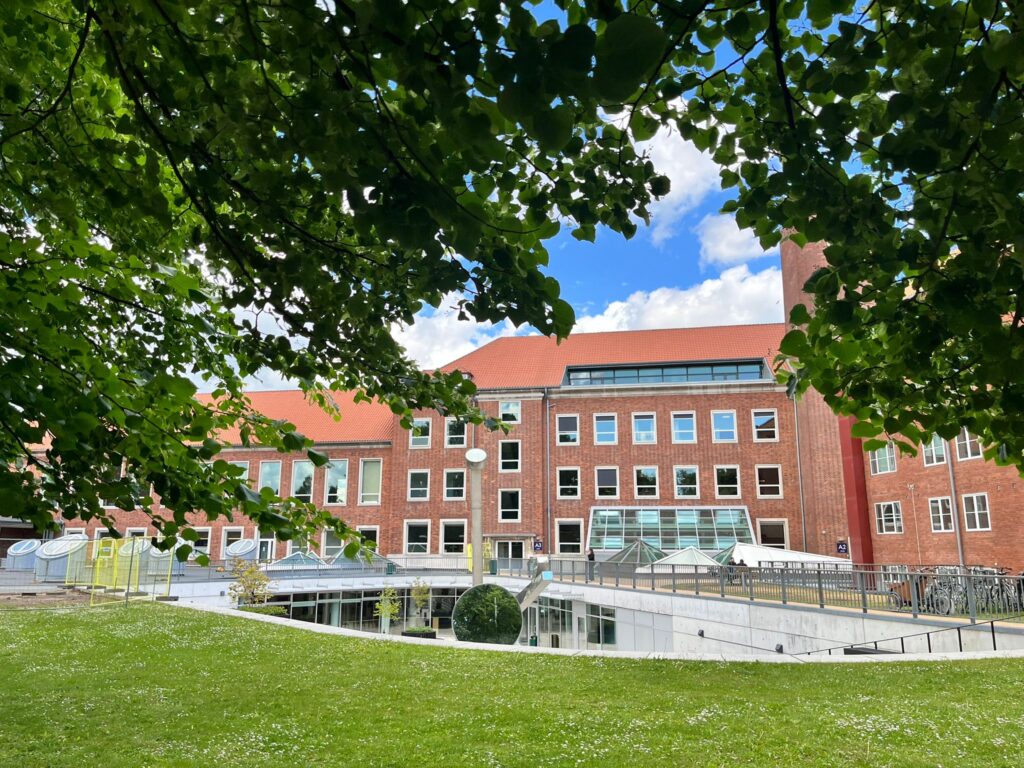
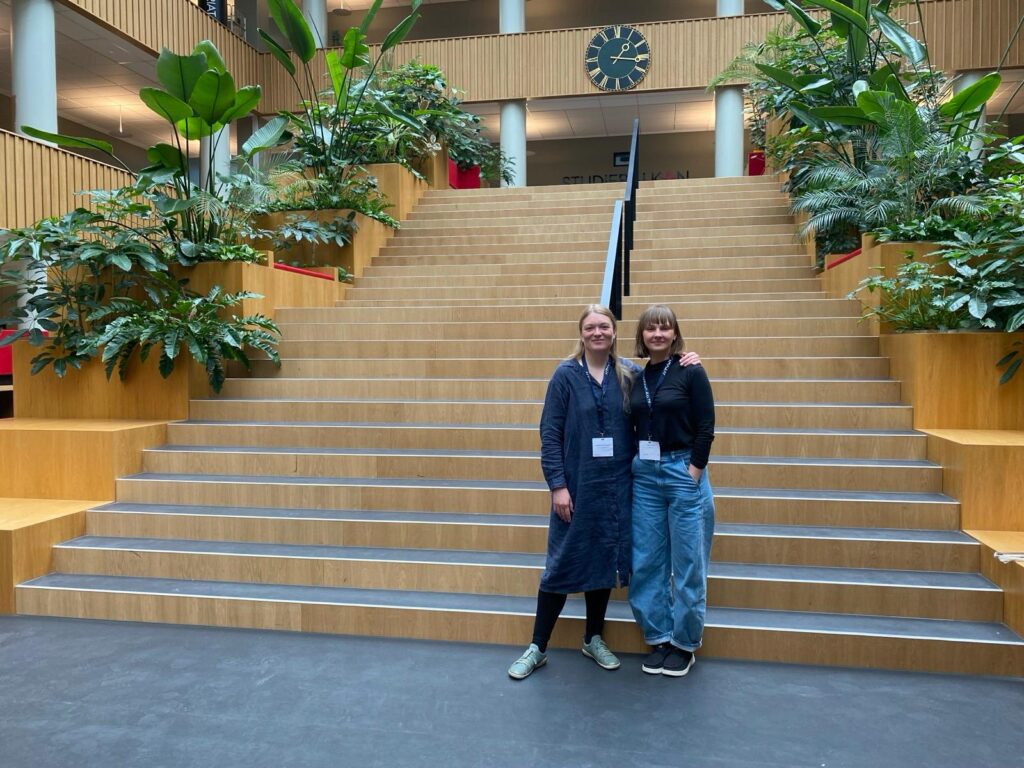
It was a pleasure to present the project “Freedom to Make Sense” (MakeSense) during a panel discussion at the Second International Conference on Embodied Education in Copenhagen. The event was organised by Oliver Kauffmann, Dag Munk Lindemann and Denis Francesconi. The aim was to bring together researchers from the field of embodied education (EE) to exchange knowledge and strengthen the emerging networks between research and practice in the field of embodied teaching and learning.
Guðbjörg R. Jóhannesdóttir, Anna Itkonnen and Monika Lindner provided an insight into the overarching MakeSense project, as well as the fundamentals of Focusing and the philosophy of the implicit, whilst addressing key concepts such as ‘felt sense’, ‘implicit order’ and an understanding of the body as ‘the body that is the situation’. In doing so, they provided a more detailed insight into their respective research projects.
Conference website: https://conferences.au.dk/embodied-education-2026
Guðbjörg R. Jóhannesdóttir presented how she incorporates embodied practices into empirical training at the Iceland Academy of the Arts. Central to this is supporting artists and becoming art teachers in their approach to research, which has always drawn upon a ‘felt sense’, a vague yet meaningful knowing.
Anna Itkonnen explained how, within the framework of her doctoral thesis ‘The Missing Epistemology of Becoming – What Does Affect Theory Mean for the Pedagogy of Thinking?’, the relevance of the subject-object question takes on a different form and, rather than leading to a dead end, brings the significance of the ‘reactive order’ into focus. Accordingly, we are always situated within a broader responsive order that encompasses us and our comparisons and – more importantly – responds to us as agents, as people who make metaphorical utterances in situations characterised by inherent complexity. A new empiricism that acknowledges both orders can enable us to navigate between them in a variety of ways.
As part of her doctoral research, in which she examines the understanding of an embodied educational situation, Monika Lindner introduced the concept of the body. According to Eugene Gendlin, the body is in constant interaction with its surroundings and therefore contains information about the environment and ‘is’ that situation. She elaborated on the importance of situational sensitivity in educational contexts and demonstrated how embodied practices such as Focusing and ‘Thinking at the Edge’ (TAE) can help to integrate this implicit knowledge into the development of an educational attitude that can provide orientation within situational complexity.
International Focusing Conference
June 3-7, Vienna, Austria
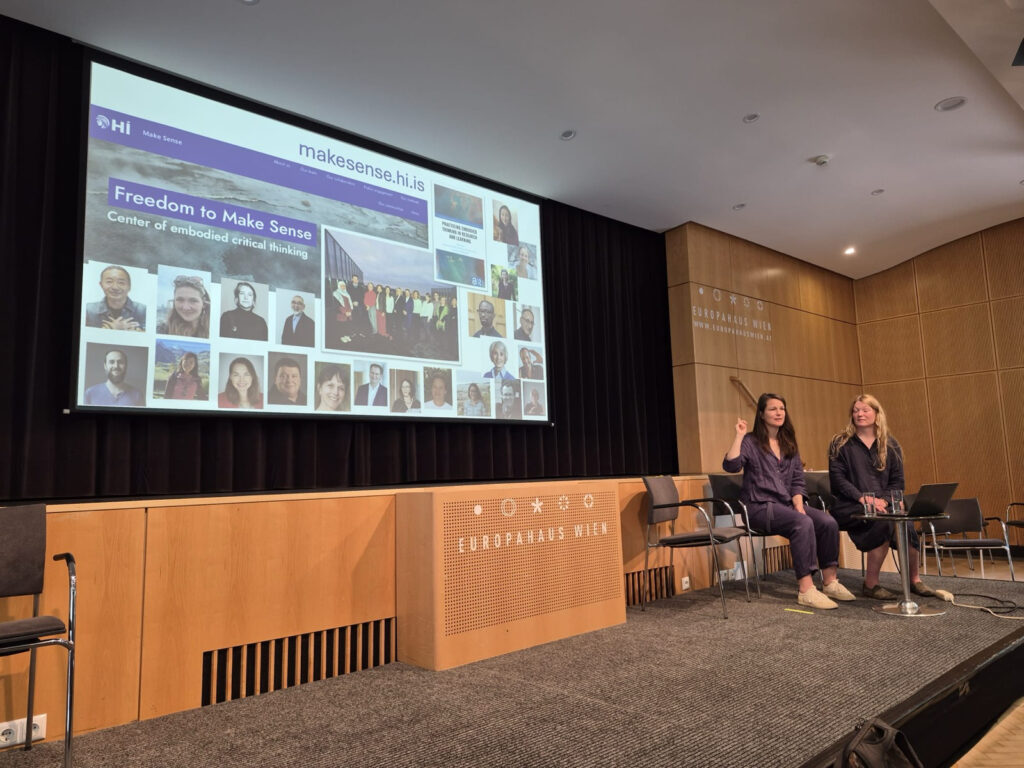
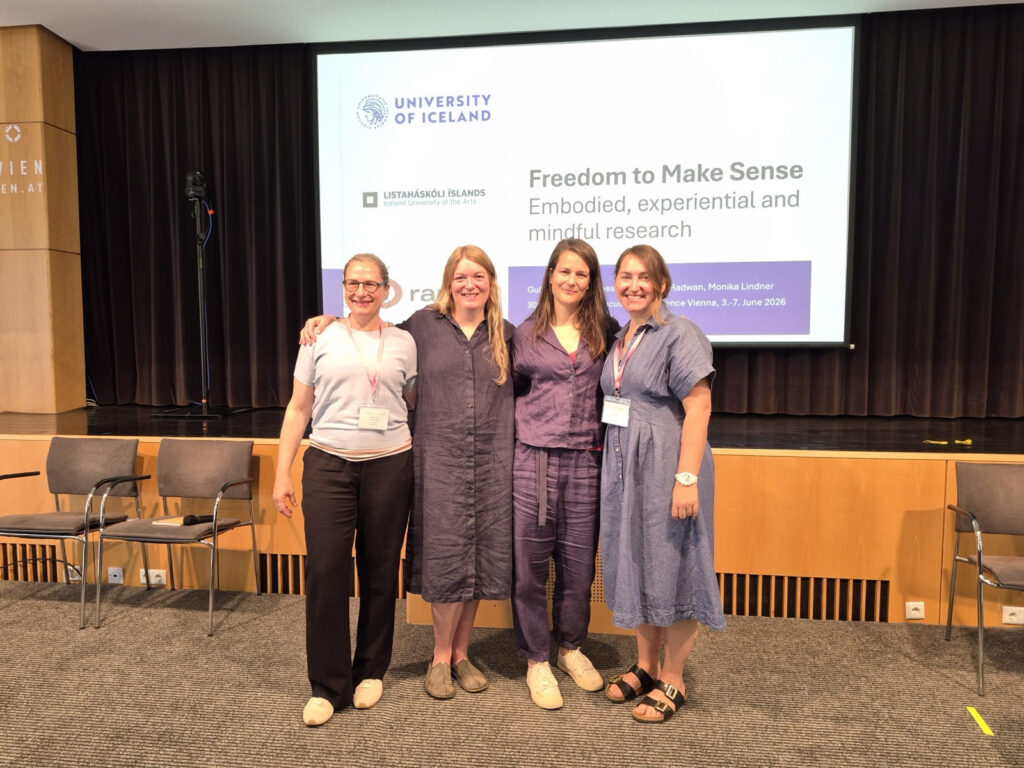
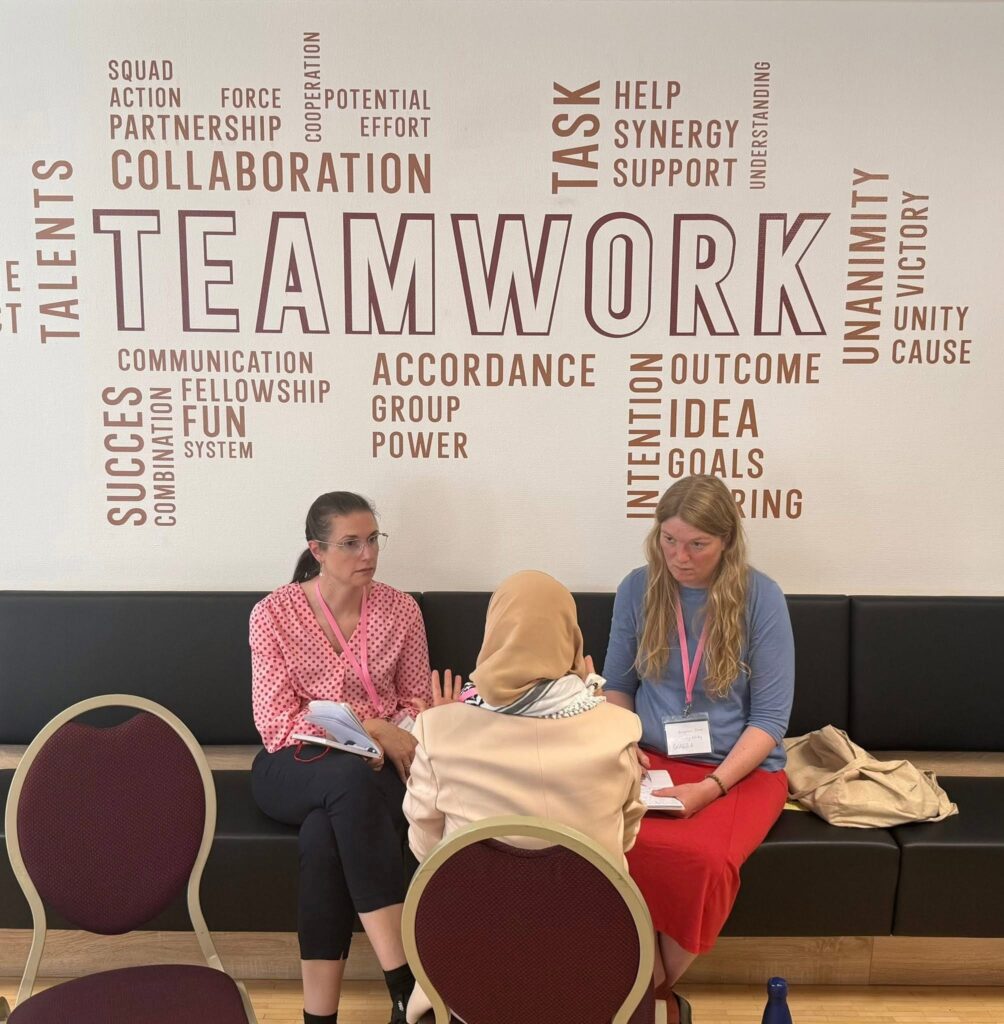
Guðbjörg R. Jóhannesdóttir, Ghada Radwan and Monika Lindner, all Focusing trainers, took part in the 30th International Focusing Conference and provided insights into the “Freedom to Make Sense” research project. To illustrate how research goes hand in hand with practical projects, an excerpt from a documentary film about Ghada Radwan’s Master’s thesis and Focusing project, “The Olive Tree Programme”, was shown. The project aims to strengthen the resilience of Arabic-speaking refugees. Two members of the wider team of collaborating partners kindly provided support: Amanda van Vegten and Anna-Katharina Lenz.
To mark the 100th anniversary of Gendlin’s birth, over 400 interested participants – including practitioners, trainers and coordinators – gathered in his hometown of Vienna from 3 to 7 June 2026.
Gendlin, who was born into a Jewish family, was forced to flee as a young boy; during their escape, he witnessed his father trusting his ‘feeling’ to lead the family to safety. The conference theme, ‘Sensing Forward’, was both an invitation to lead and participate in around 100 workshops, interest groups and change groups, and an urgent challenge to come together as an inclusive community to create space and live out ‘Sensing Forward’ amidst our current complexities – in times of ongoing crises, wars and cultural diversity, in which tragic patterns from Gendlin’s early childhood are a reality for some today.
The conference was partly broadcast live, and recordings, such as our project presentation, will be available on the International Focusing Institute’s website.
Live stream and YouTube channel: ttps://focusing.org/more/livestreaming-vienna-international-focusing-conference
Conference website: https://focusing.org/event/international-focusing-conference-vienna-2026
Gendlin’s philosophy of felt understanding
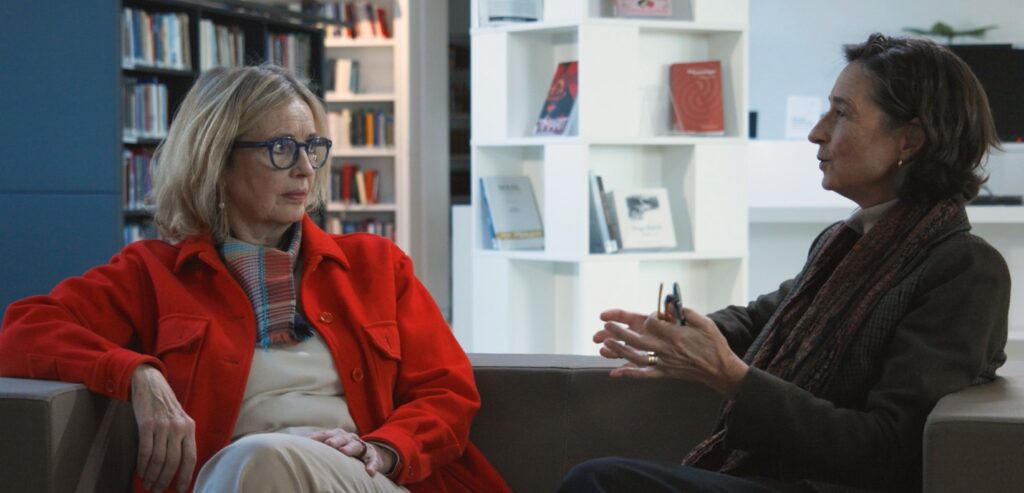
In this podcast, Sigríður Þorgeirsdóttir and Donata Schoeller introduce the uniqueness of Gendlin’s philosophy and discuss how the felt-sense approach fosters critical creativity in their thinking while continually challenging habituated dualistic frameworks of body and mind.
What is Thinking at the Edge (TAE)?
In this podcast, Sigríður Þorgeirsdóttir and Donata Schoeller discuss Thinking at the Edge as a novel philosophical practice and explore how it can be understood as methodologically complementing traditional approaches of critical thinking, by challenging a disembodied understanding of the mind.
Freedom to Make Sense at Beyond the Mind: Organising for Eco-Embodied Scholarship
June 8-11, Hazel Hill Wood near Salisbury, England
From 8–11 June 2026, Lovísa Eiríksdóttir, postdoctoral researcher in the Freedom to Make Sense project, participated in the conference Beyond the Mind: Organising for Eco-Embodied Scholarship at Hazel Hill Wood near Salisbury, England. The gathering brought together scholars and practitioners from fields including sustainability, economics, business studies, and the arts to explore more embodied and ecologically attuned approaches to scholarship.
Lovísa facilitated a two-hour workshop introducing Thinking at the Edge to business scholars and educators, inviting participants to explore how embodied knowing can contribute to research, teaching, and organizational practice.
Set in the unique woodland environment of Hazel Hill Wood, the conference combined academic dialogue with shared practical activities, creative practices, walks, music, meditation, and communal care for the site. The event was organised by Steffen Böhm, Friederike Döbbe, and George Ferns, with support from ephemera: theory & politics in organization, which is preparing a special issue based on the gathering.
The Freedom to Make Sense research group works actively to reimagine how we create academic life and how we show up at academic gatherings. We are grateful for opportunities to connect with other like-minded scholars and research groups who are exploring similar ways of fostering more embodied, collaborative, and meaningful academic practices.
New documentary about Eugene Gendlin
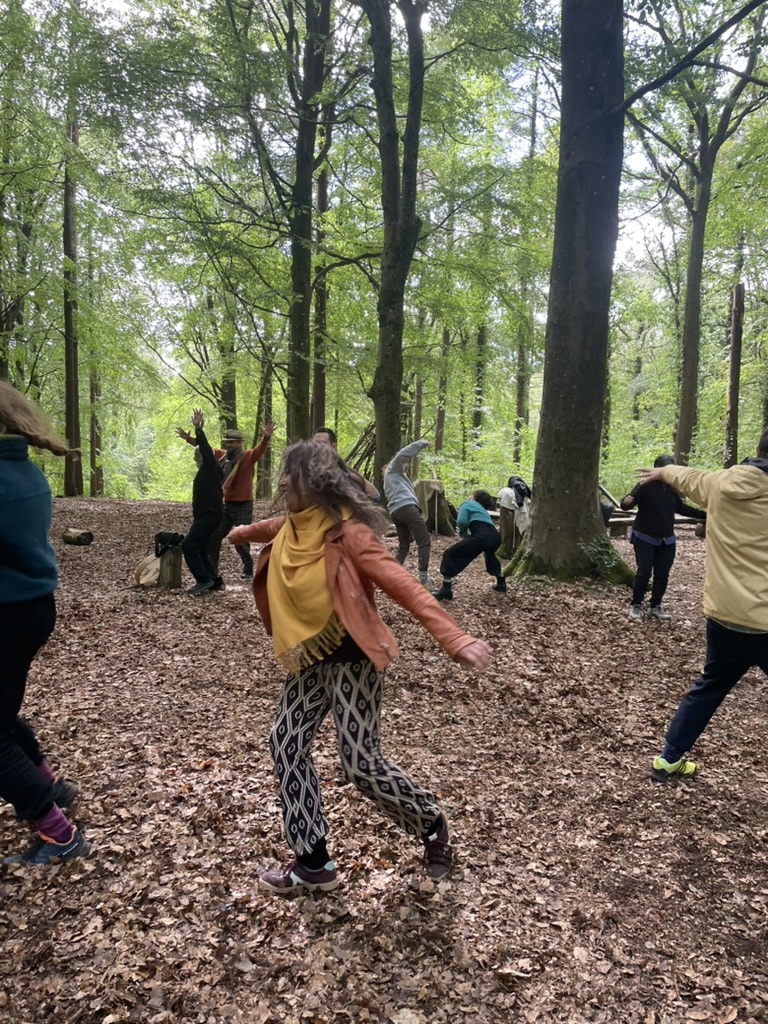
A new documentary about the philosophy of Eugene Gendlin is out. Created to mark the 100th anniversary of his birth and premiered at a conference that took place in Vienna in June 2026 in honor of his work. Gendlin is likely the philosopher who has influenced the Freedom to Make Sense project the most. He showed that philosophical thinking is accessible to all of us. It begins with a felt sense of an issue and develops through an attempt to grasp something as a meaningful whole. It is a way of thinking that helps us become more fully ourselves while deepening our understanding of others.
April 2026
Practicing Embodied Critical and Creative Thinking — Together
April 19. – 26, Bernried, Germany
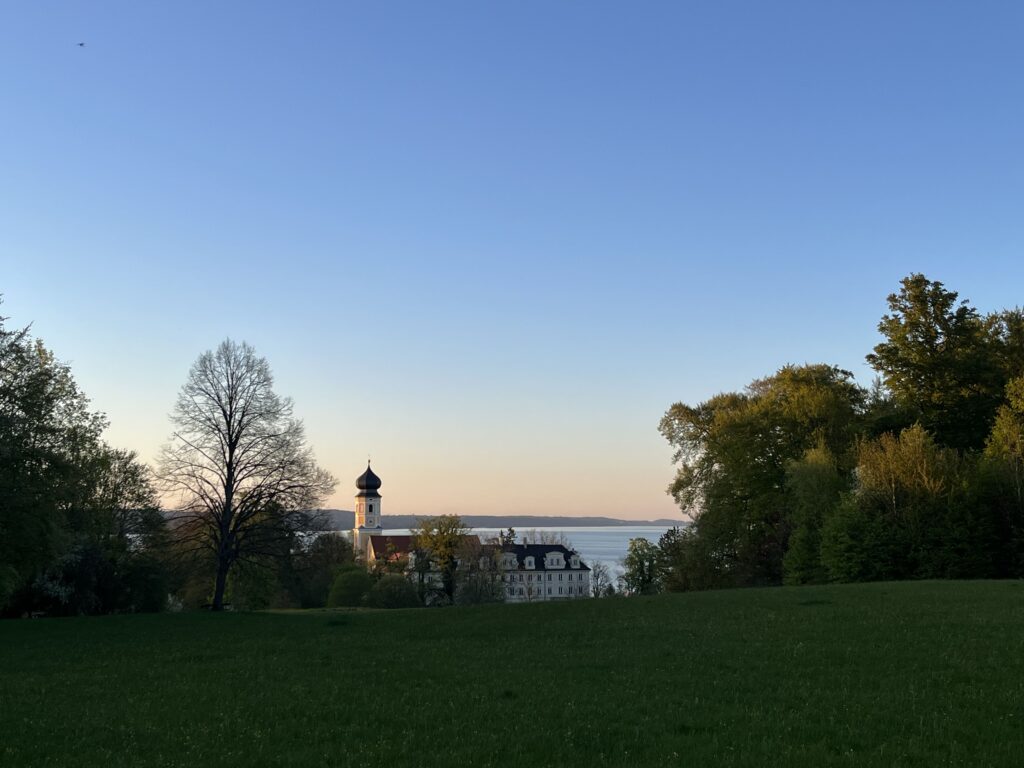
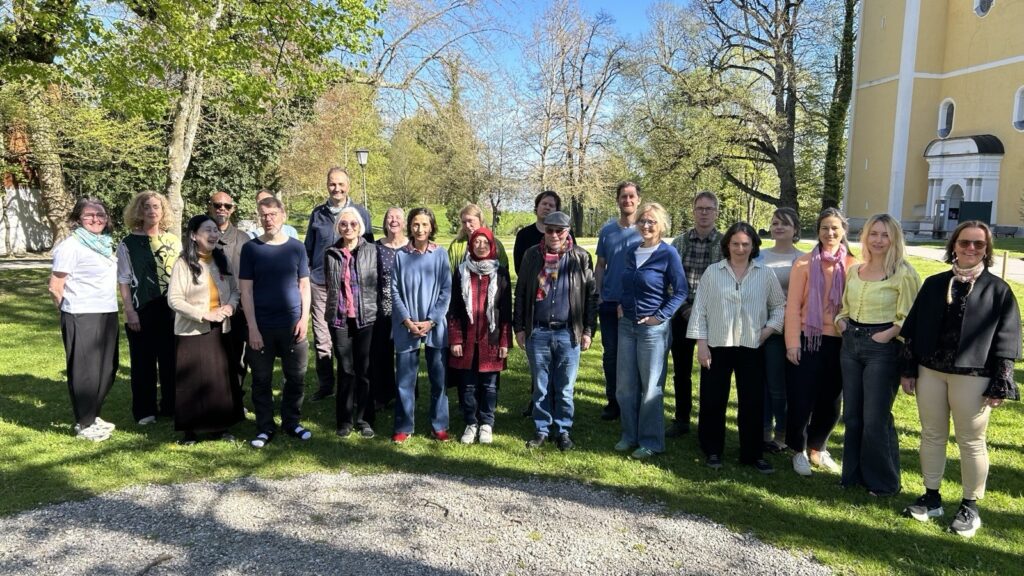
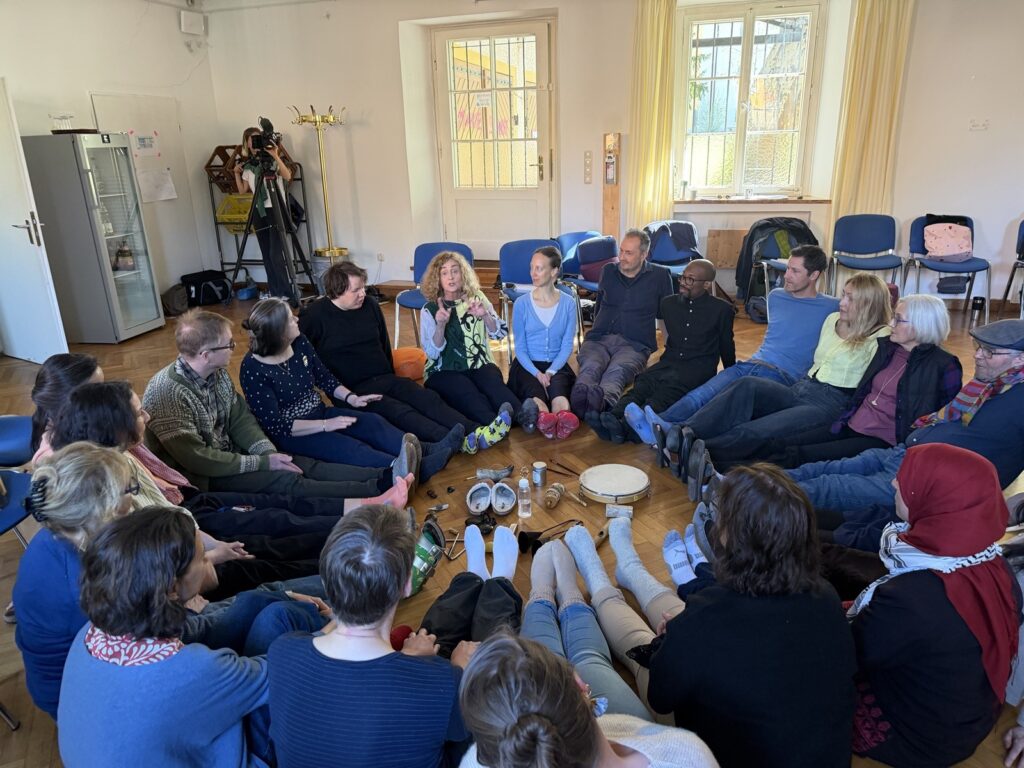
The MakeSense international research project recently spent an intensive week in Bernried, Bavaria, exploring and advancing methods of embodied philosophical, creative, and critical thinking.
We were 25 researchers from over 20 universities, coming together from Australia, the USA, Canada, Europe, Japan, and the Middle East — united by a shared commitment to doing philosophical thinking in practice. We are philosophers, artistic researchers, psychologists, cognitive scientists, and more.
What makes our work distinctive is the leap into practice.
We do not only investigate the theoretical and scientific foundations of embodied thinking — thinking grounded in lived experience and the felt sense.
We also train and develop methods such as:
– Focusing
– Thinking at the Edge (TAE)
– Micro-phenomenological interviewing
– Mindfulness-inspired research practices
– Artistic research approaches
This integration of practice and research places our project at the forefront of international developments in embodied thinking.
📘 Our open-access book:
Practicing Embodied Thinking in Research and Learning
by Donata Schoeller, Sigridur Thorgeirsdottir, and Geoffrey Walkerden.
The Bernried workshop generated new insights, discoveries, and directions for our ongoing research and future collaborations.
We were also joined by a filmmaker, who documented our work and conducted interviews for an upcoming film on embodied research practices.
At a time of AI expansion and increasingly disembodied modes of thinking, our work asks:
How can we bring lived, embodied meaning-making back into higher education?
This is what we are building — together.
#EmbodiedThinking #MakeSense #PhilosophyInPractice #HigherEducation #AIandHumanThinking #Focusing #TAE #ResearchInnovation
February 2026
Conversation about Embodied Critical Thinking
February 9th
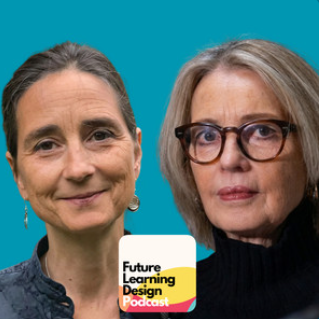
Sigríður Þorgeirsdóttir and Donata Schoeller were guests on the Future Learning Design Podcast. The episode challenges the long‑standing assumption that critical thinking is simply a neutral, logical skill set. Instead, it draws on emerging cognitive science to show that reasoning is inseparable from emotion, embodiment, and lived context. The implications for education are significant, pointing toward more sophisticated approaches to teaching critical thinking across disciplines – from mathematics to philosophy.
You can listen to the conversation here.
If you’re interested in finding out more about the upcoming training with Donata and Sigríður, check out the link here.
January 2026
Aesthetics and Sustainability Meet in Granada
January 29-30th
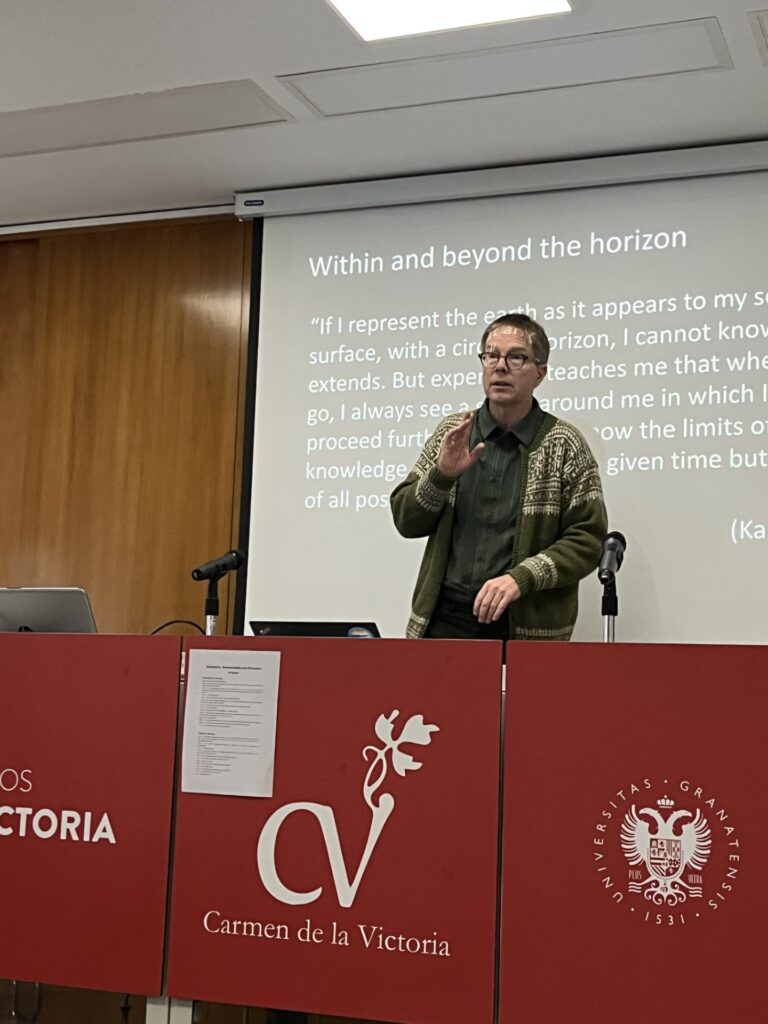
The University of Granada hosted an international workshop titled “Aesthetics, Sustainability and Education” at the historic Carmen de la Victoria on 29–30 January, bringing together researchers, artists, and educators to examine how aesthetic experience can deepen public engagement with ecological issues.
Organizers emphasized that transformative learning requires more than information — it demands affective and aesthetic shifts in how people perceive the world and their place within it. The workshop therefore explored how environmental aesthetics and the aesthetics of science might foster more attentive, caring, and sustainable forms of relating to nature.
The program combined lectures by senior scholars with short project presentations and group sessions led by early‑stage investigators, creating a collaborative environment for interdisciplinary exchange.
Ólafur Páll Jónsson, as well as being one of the workshop’s organizers, delivered a lecture titled “Hope and Material Reality.” This talk examined how hope can be grounded in material reality by contrasting abstract notions of the horizon with concrete, experiential accounts from Thoreau and visual art.
Also presenting were Gunndís Ýr Finnbogadóttir who presented “Unstable Ground” and Monika Lindner, who contributed a poster titled “An Experiential Perspective: Relating to Oneself Is Caring for the World.”
For more information see the website of the event here.
You can also find impressions on LinkedIn here.
Gendlin Research Center Opens 2026 Philosophy Prize
January 5th
The Gendlin Research Center has opened submissions for the 2026 Gendlin Philosophy Prize, a $1,000 award recognizing outstanding scholarship on the work and thought of Eugene Gendlin. The competition is open to scholars, current graduate students in philosophy or related fields, as well as individuals who completed a Master’s degree or Ph.D. within the past four years. Submissions must engage substantively with Gendlin’s philosophy.
Papers may not exceed 2,500 words. The winning author will be invited to present their work in a public online event moderated by members of the Gendlin Research Center. Entries are due April 1, 2026 and prize decisions will be announced by June 1, 2026.
For additional details click here

December 2025
Conversation with Greg Madison
Dec 11th
On the 11th of December Sigríður Þorgeirsdóttir had a conversation with Greg Madison on his podcast The Living Process. The conversation delved into the unique experience of teaching embodied reflection to philosophy students. Sigríður shared insights on how this approach can deepen understanding and foster a more holistic form of learning, bridging the gap between abstract reasoning and lived experience. Sigríður emphasised the necessity of cultivating an environment where students are not only encouraged to question and analyse but also supported in developing the confidence to express their perspectives.
The conversation extended to contemporary issues surrounding Artificial Intelligence. Sigríður and Greg compared the processes of machine learning and human thinking. While AI can process vast amounts of information and identify patterns at impressive speeds, they discussed how human cognition remains distinctive in its capacity for embodied understanding, emotional nuance, and ethical deliberation.
This episode offered a rich exploration of what it means to think critically and reflectively in today’s world – both as individuals and within academic communities. Sigríður’s insights on embodied reflection, the challenges of imposter syndrome, and the evolving role of Artificial Intelligence provided valuable food for thought, underscoring the ongoing relevance of philosophy in navigating contemporary challenges.
November 2025
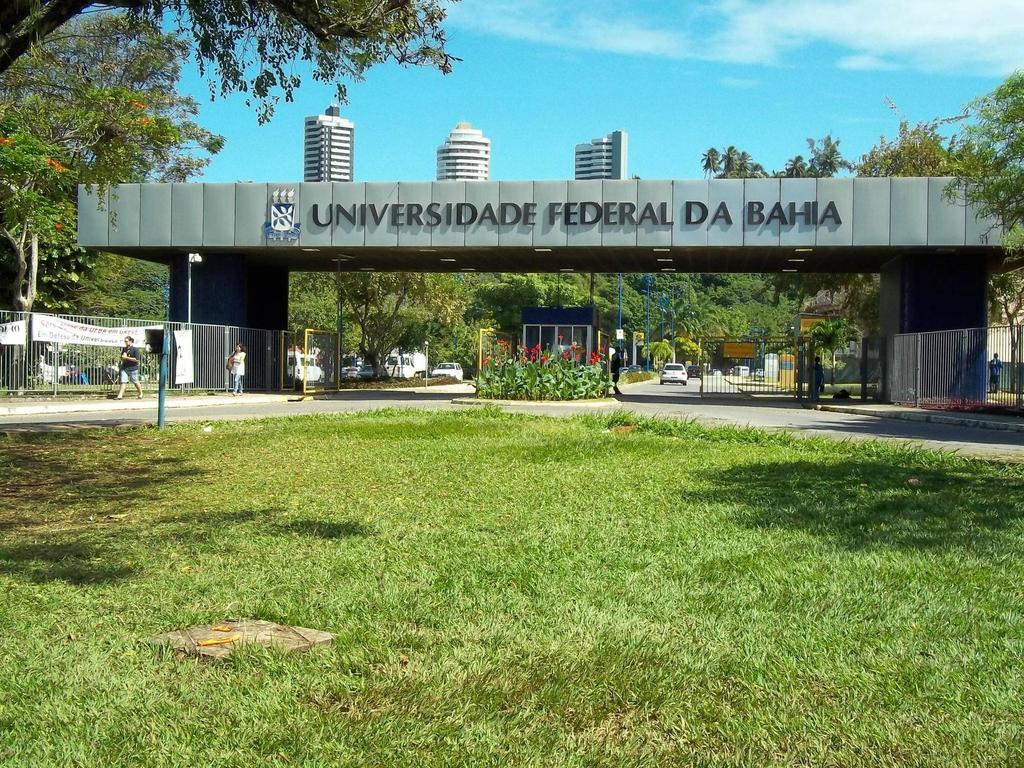
Lecture at the University of Bahia in Brazil
Nov 26th
On November 26, Sigríður Þorgeirsdóttir delivered a lecture titled Philosophy as Eros: Thinking with a Felt Sense at the University of Bahia in Brazil. In her talk, she explored how Socratic methods of inquiry can be reinterpreted in light of contemporary research on the embodied and experiential foundations of thought.
Her central argument was that the growing presence of AI in higher education creates both an opening and an urgent need to cultivate embodied philosophical practice—critical thinking rooted in lived, felt experience—across all levels of academia.
The lecture unfolded in three parts:
- The ancient roots of Eros in Plato’s Symposium.
- The link between love and philosophy as a source of inspiration in contemporary feminist philosophy.
- Philosophizing from a felt sense as a way of practicing philosophy as Eros—understood both as desire for knowledge and as the courage to think independently.
Throughout her discussion, Sigríður emphasized Eros as a particular conception of love: a driving force in philosophical reflection. She highlighted that philosophizing from a felt sense represents a contemporary mode of practicing philosophy as Eros. This approach, exemplified in Eugene Gendlin’s work, cannot be fully grasped through theory alone—it requires direct experience and a genuine leap into practice.
For those interested in exploring this leap further, an open-access book has emerged from a research project on embodied methodologies of philosophical thinking: Practicing Embodied Thinking in Research and Learning, edited by Donata Schoeller, Sigríður Þorgeirsdóttir, and Greg Walkerden (Routledge, open access). Read the book here.
Conference about Artificial Intelligence in Education at the Teacher's Academy
Nov 21st
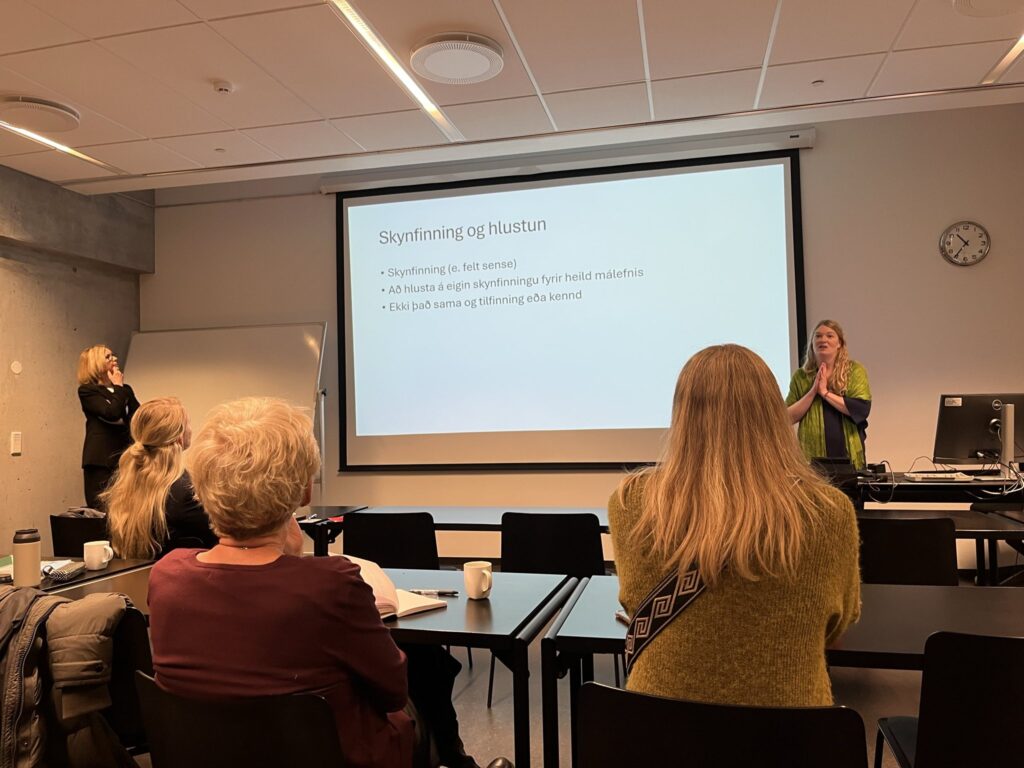
On November 21st there was a Conference on artificial intelligence in education and pedagogy at the Teacher’s Academy. Sigríður Þorgeirsdóttir, Guðbjörg R. Jóhannesdóttir and Björn Þorsteinsson did a presentation on the benefits of bringing the methods from the Freedom to Make Sense project into the classroom. Their presentation had the name Freedom to Make Sense: Embodied, Experiential and Mindful Learning in Higher Education. They addressed the issues regarding artificial intelligence in higher education from the perspective of embodied organic intelligence.
A Workshop for Teachers
Nov 15th
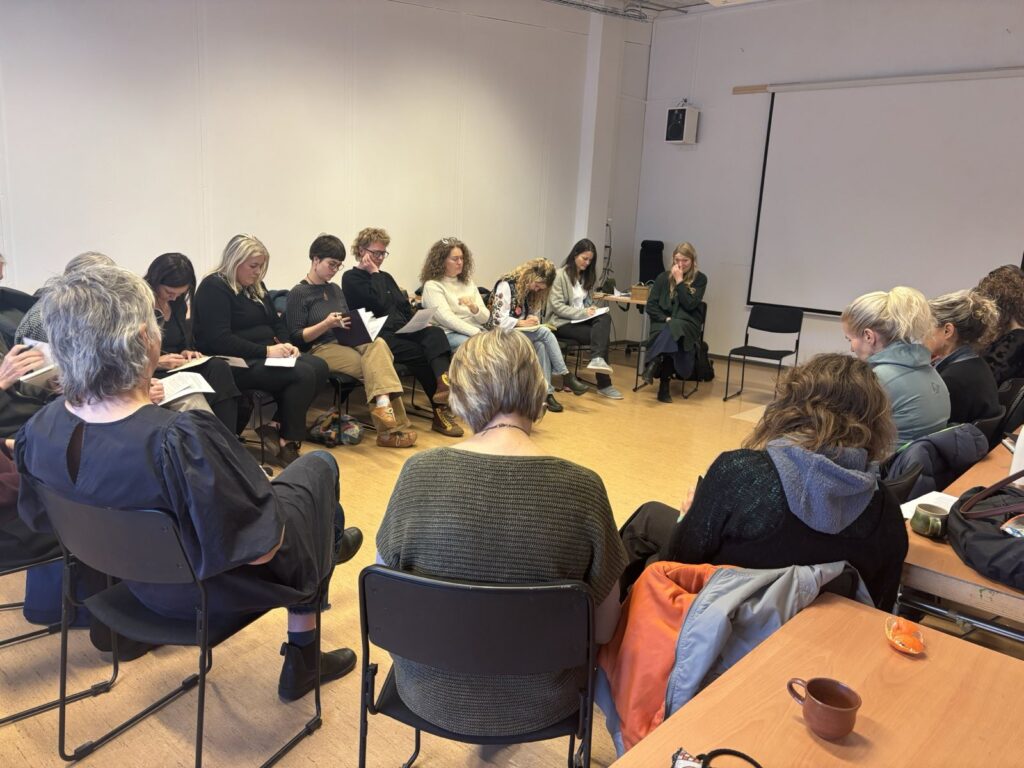
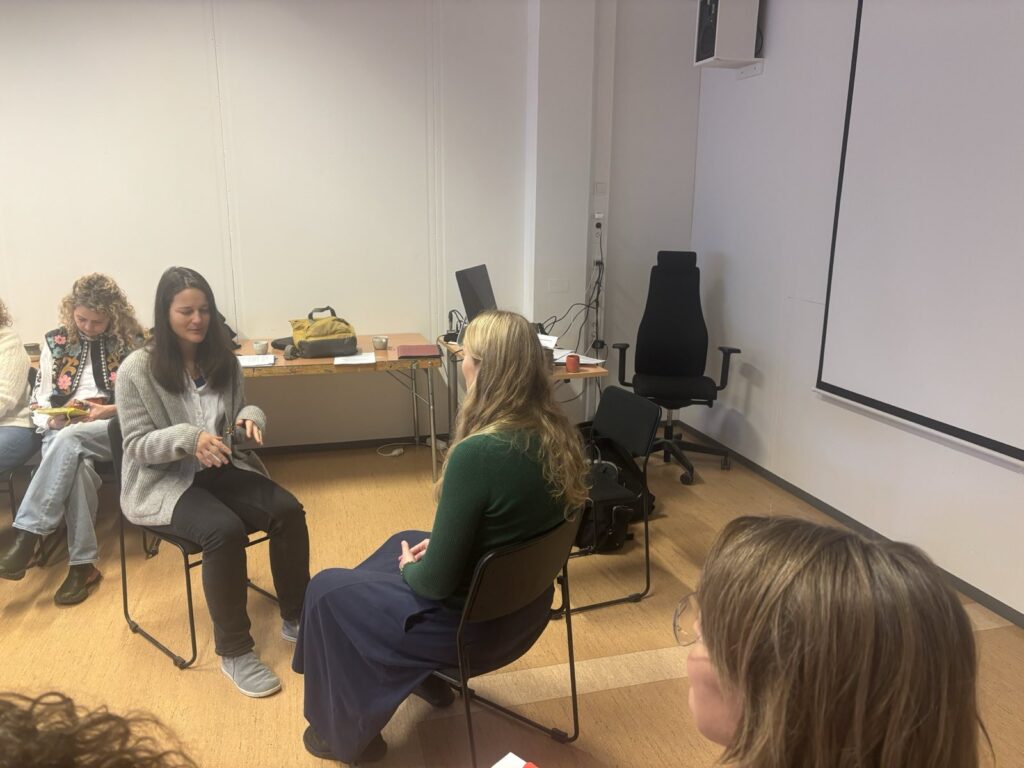
On 15 November, a MakeSense workshop for upper secondary (gymnasium) teachers titled “I Am My Own Laboratory: Cultivating Felt Sense and Attentiveness in Education and Teaching” was held. Twenty teachers from Fjölbrautaskólinn í Breiðholti (FB) and The Reykjavík School of Visual Arts attended. The workshop was facilitated by Guðbjörg R. Jóhannesdóttir, Monika Lindner, and Sigríður Þorgeirsdóttir, who introduced methods of embodied critical and creative thinking. These approaches can be traced back to the University of Chicago and the work of Eugene Gendlin, Mary Hendricks, and others.
The workshop aimed to:
demonstrate simple steps for working with felt sense in education
practice attentive listening
explore ways to find one’s own voice and greater clarity
These methods support teachers in cultivating attentiveness, independent critical thinking, and constructive communication in the classroom. In the age of artificial intelligence, it is especially important for students to stay in touch with the embodied grounds of their own thinking.
October 2025
Lecture at Fjölbrautarskólinn in Breiðholt
Oct 9th
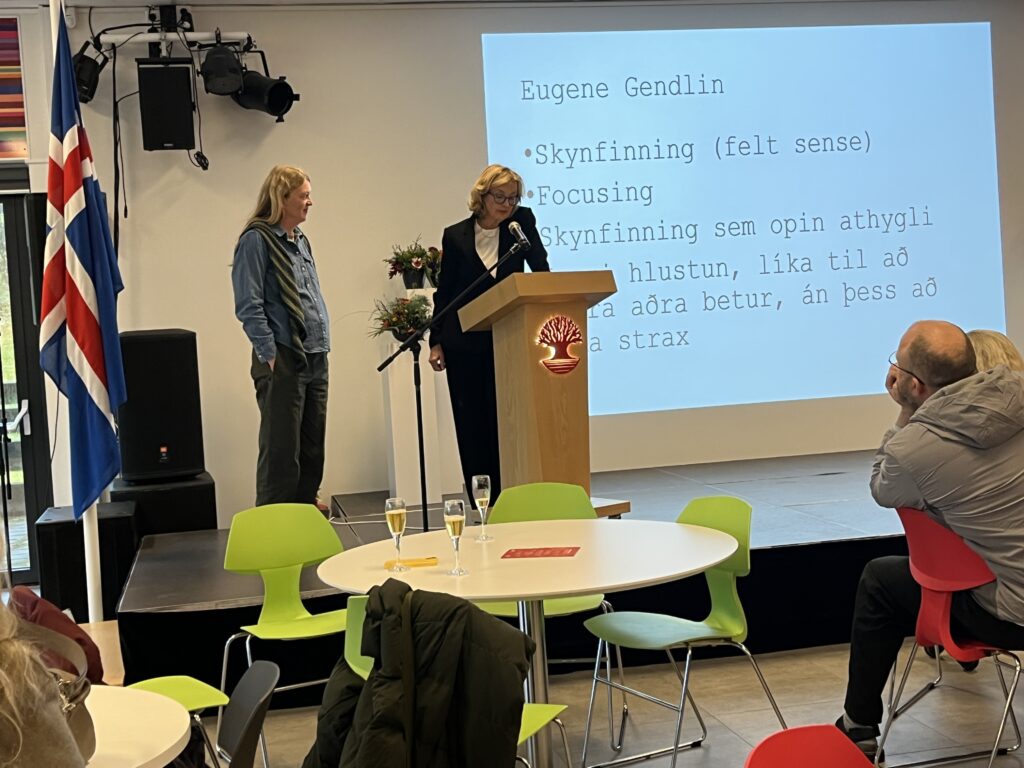
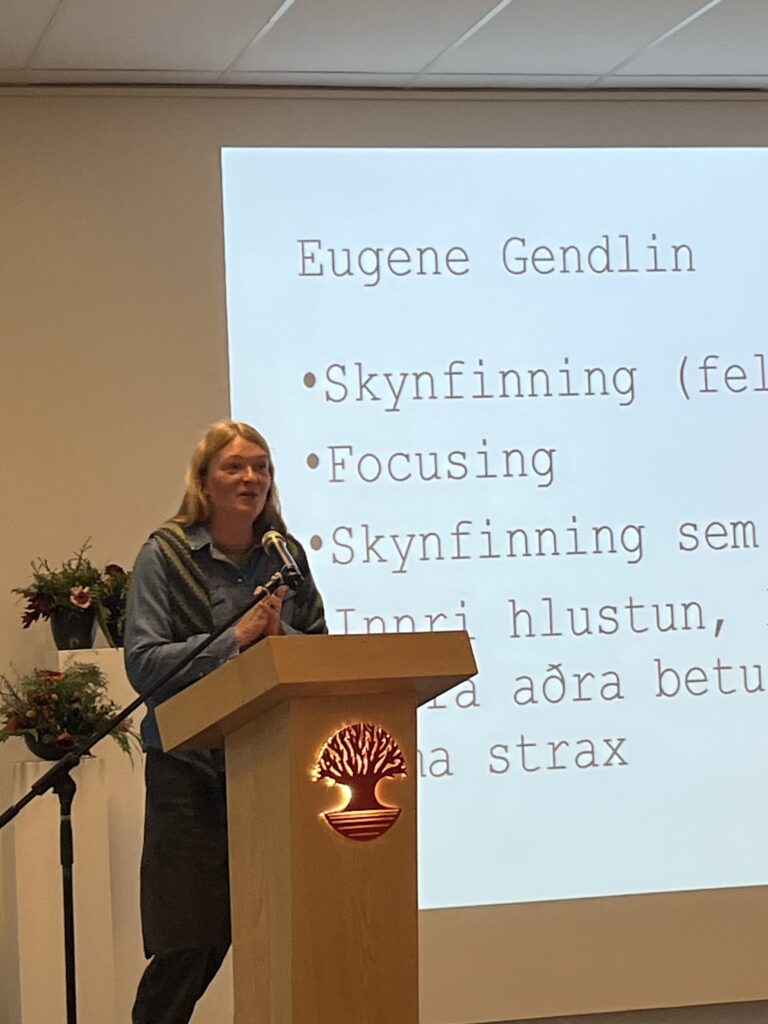
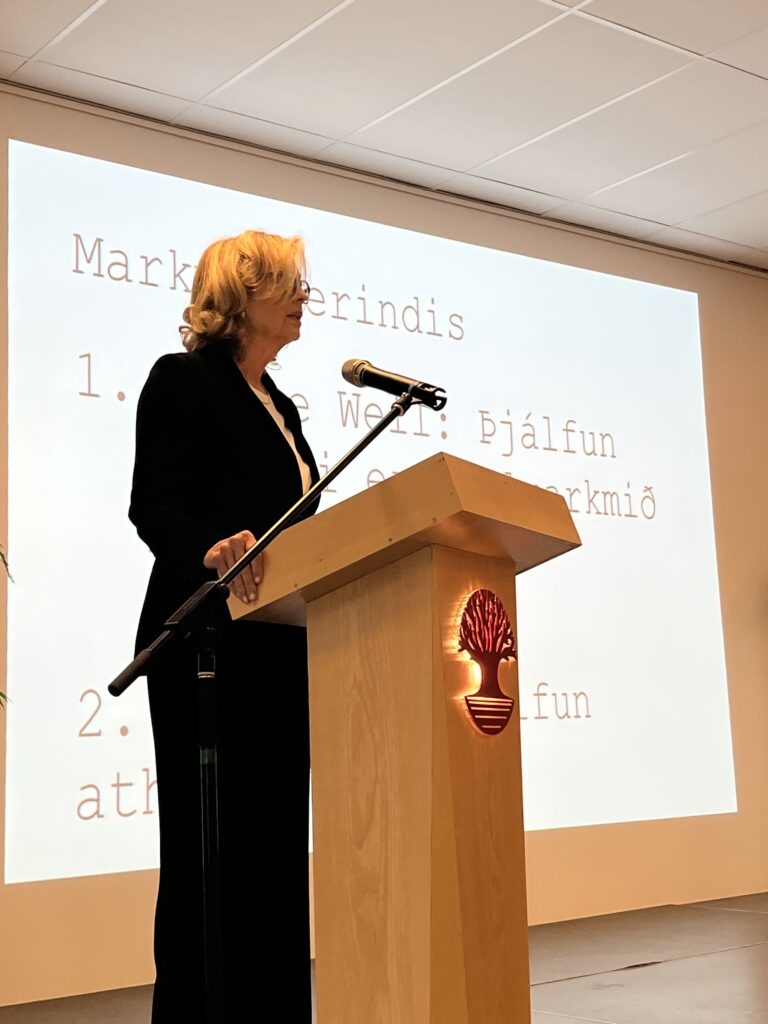
Sigríður Þorgeirsdóttir delivered a lecture at Fjölbrautaskólinn í Breiðholti (FB) on 9 October titled “The Battle for Attention,” examining how attention functions in schools and education in an era shaped by social media, the internet, and AI. Drawing on Simone Weil’s claim that training attention is the central aim of education, Sigríður outlined a philosophy of attention and introduced Eugene Gendlin’s Focusing-based methodology of embodied thinking as a practical approach to cultivating attention at all educational levels. Monika Lindner and Guðbjörg R. Jóhannesdóttir guided participants through exercises to experience these methods firsthand.
This talk opened a lecture series hosted by Fjölbrautaskólinn í Breiðholti in celebration of the school’s 50th anniversary. FB is one of the largest gymnasiums in Iceland, with nearly 2,000 pupils, and the audience comprised school leaders and teachers.
May 2025
The Olive Tree Programme
May 30 - June 3
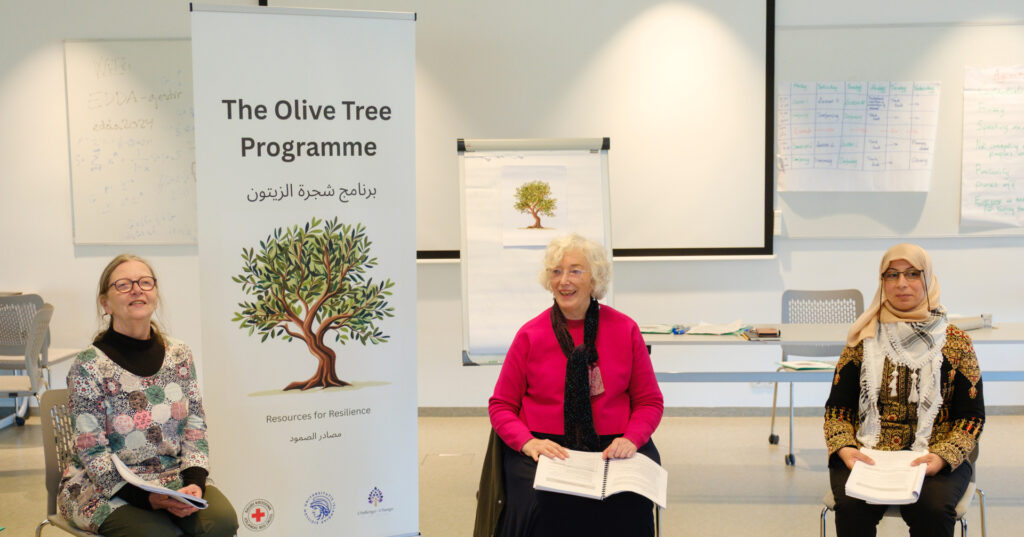
The Olive Tree Programme was held at the University of Iceland from May 30 to June 3. The Olive Tree Programme aims to train individuals in methods that enable them to develop resilience and emotional endurance. The instructors were Margaret Quinn, Tom Larkin, and Mary Jennings from the Irish Focusing Network. They have decades of experience in training and applying embodied-cognitive techniques such as focusing, which are rooted in a felt sense for issues and problems.The methodology of focusing was developed by Eugene Gendlin at the intersection of psychology and philosophy.
The project manager and fourth instructor of the programme is Ghada Radwan, a master’s student at the School of Education at the University of Iceland. The Olive Tree Programme is part of her master’s thesis. The project is also part of the interdisciplinary research initiative Freedom to Make Sense (www.makesense.hi.is), a collaboration between researchers at the University of Iceland and the Iceland University of the Arts, as well as an interdisciplinary group of researchers from over 20 universities and research institutions around the world.
Participants in the course work with Arabic-speaking immigrants through various institutions in Iceland, including the Icelandic Red Cross, the City of Reykjavík, the Municipality of Kópavogur, and the Muslim Cultural Center in Iceland. At the end of the course, participants received certification to teach the methods in their own professional settings. The project was funded by the Development Fund for Immigration Affairs and the Swiss organization Challenge to Change, with support from the Icelandic Red Cross and the research project Freedom to Make Sense.
In the philosophical podcast Siggasophy (Sigguspeki), the team discusses how the program draws on the Focusing-based psychology and philosophy of Eugene Gendlin, offering a grounded, embodied approach to healing, resilience and life skills.
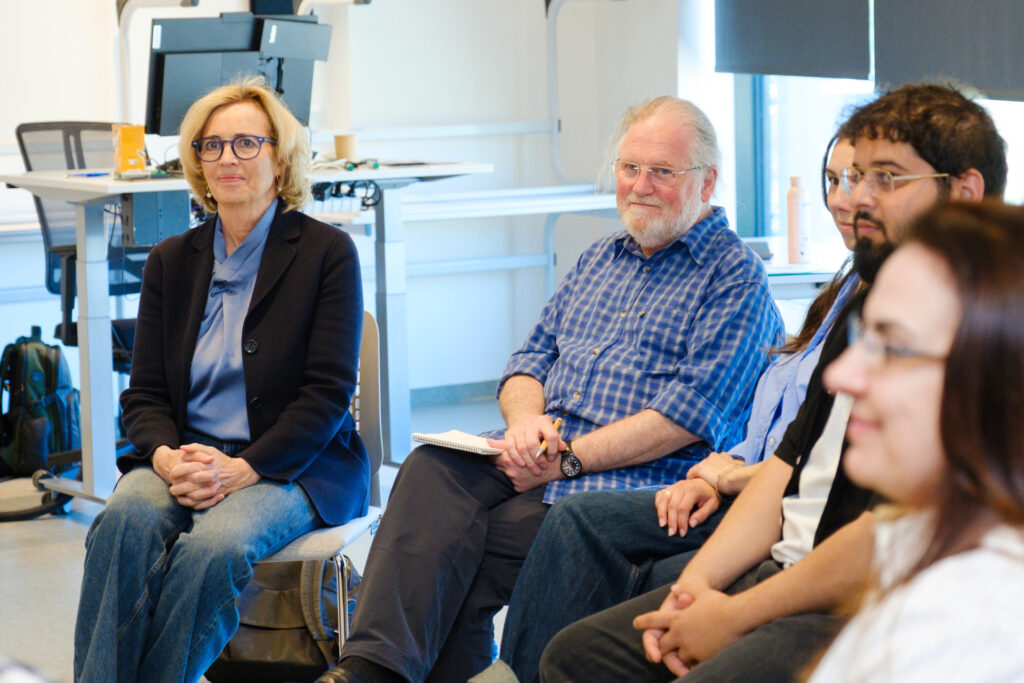
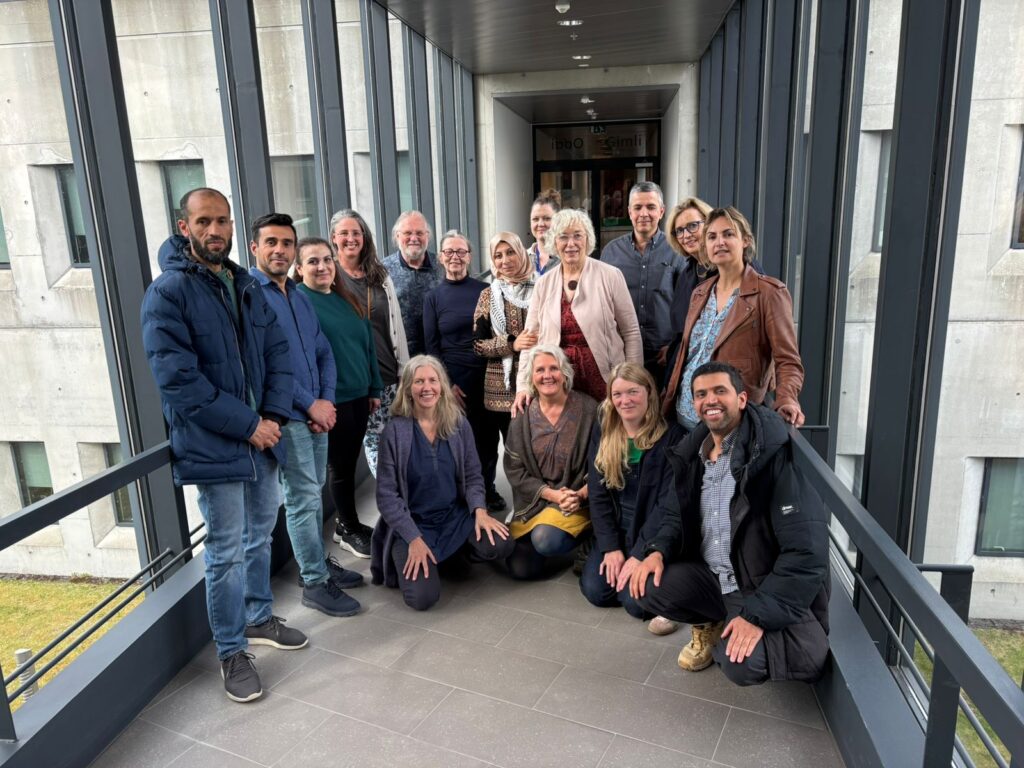
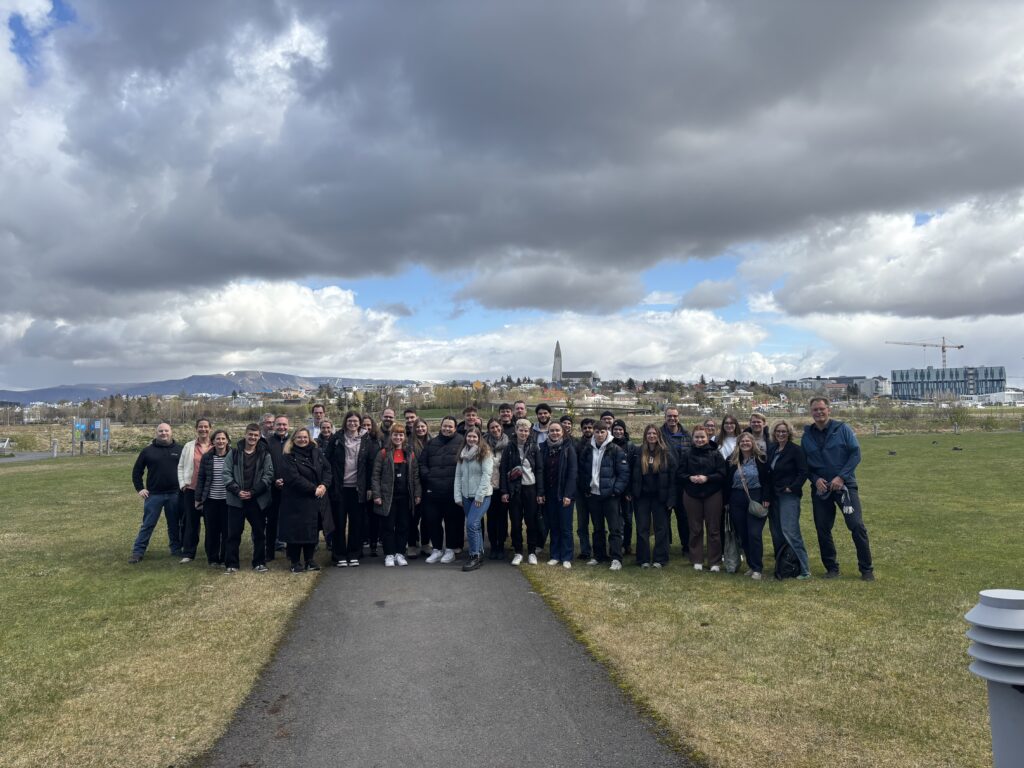
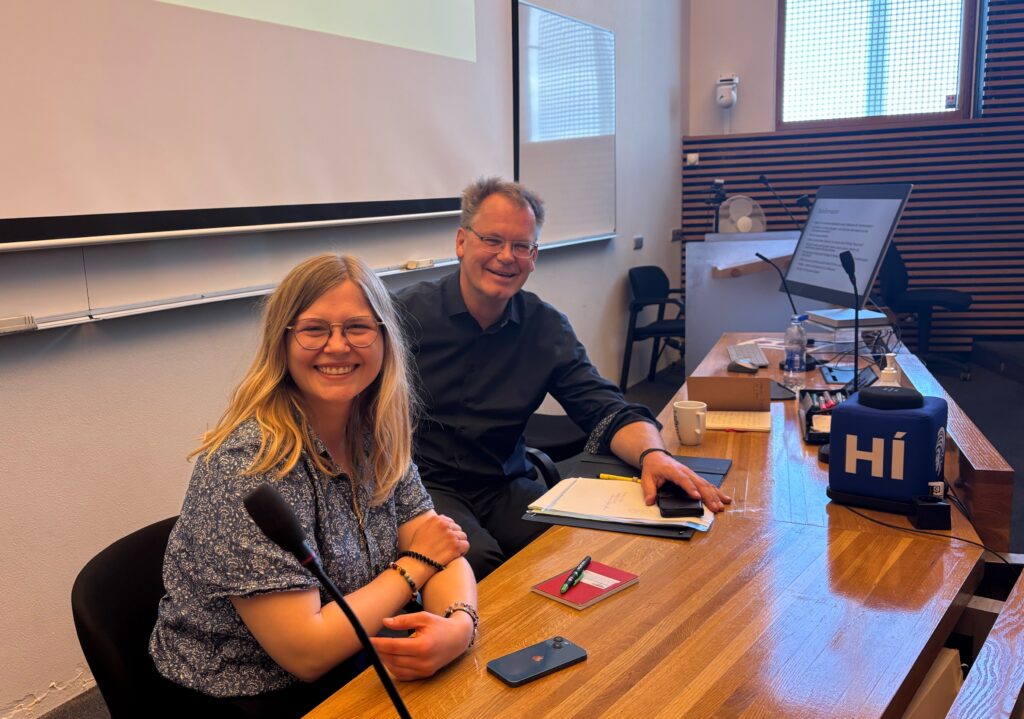
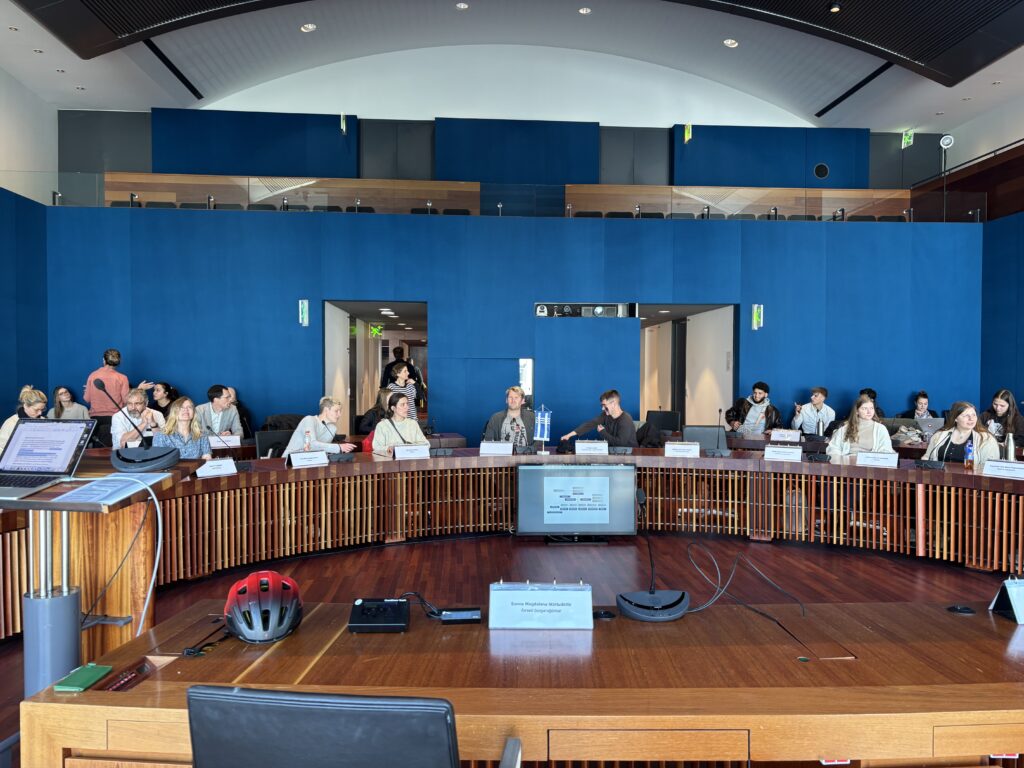
Visit from Darmstadt University of Applied Sciences
May 5-10, 2025
April 2025
Thinking At The Edge (TAE) Symposium
Exploring Experiences and Applications of TAE
April 4-6, 2025, online
The International Focusing Institute (TIFI)
The International Focusing Institute (TIFI) is dedicating a symposium to “Thinking at the Edge” (TAE). Members of the Freedom to Make Sense research group will participate with their own presentations and in panel discussions.
Thinking at the Edge (TAE) is a systematic way to think about our world and ourselves by directly referring to a felt sense. The TAE process starts from a knowing for which we don’t have words yet. The words and concepts that we know from public life tend to paint with a broad brush; public language seldom captures precisely what we are experiencing. The steps of TAE help us to develop a fresh use of language, to find just the right words which truly fit what we want to say. We learn through TAE to let words emerge gradually from the felt sense. Then, from our unique expression, TAE helps us to find ways to express our knowing in generalized terms as well, so that our insights can be communicated to others. In this way, our work in TAE can open new possibilities not only for ourselves but for others as well.
This symposium is meant as a chance for those who have at least a basic knowledge of TAE to share your knowledge, your insights, your enthusiasm, your questions and your edges with other attendees. We will have chances for informal TAE-based conversations or partnerships.
More information and registration (still possible; recordings are available): TAE Symposium
Donata Schoeller and Sigga Thorgeirsdottir – Bringing TAE to Higher Education
Over the past nine years, Sigga and Donata have worked to bring Gendlin’s methodology of focusing-based thinking into teaching and research at the university level.
To this end, they have gathered leading scholars and practitioners of Gendlin’s philosophy, psychology, and methodology from around the world, aiming to make his work better known within academia.
In this session, Donata and Sigga will discuss both the obstacles and successes of integrating Gendlin’s philosophy and methodologies into higher education and philosophy.
They also hope to have time to engage in the philosophical practice of TAE. By practicing together, we will experience the richness of a TAE movement, which enacts the interplay between experiencing and conceptualization as a responsive dance.
We will explore a TAE move on two levels: first, by honing the insights that emerge during the practice, and second, by reflecting on the move itself as we practice it. Both levels help us better understand what TAE reveals about the human capacity for thought, as well as the delicate, embodied magic of this capacity—something that, in an age of AI, is in need of cultivation.
Satoko Tokumaru – Enjoy Crossing
Satoko learned about TAE in 2004 and has been teaching it for over 20 years. Her experience teaching TAE to a large number of students at a university has transformed her TAE into something that is easy to understand. She has developed a number of exercises that allow you to learn the important points of TAE in a short amount of time. In this workshop, you will experience one of them: „Enjoy Crossing.“ Participants should prepare two photos that you like in advance.
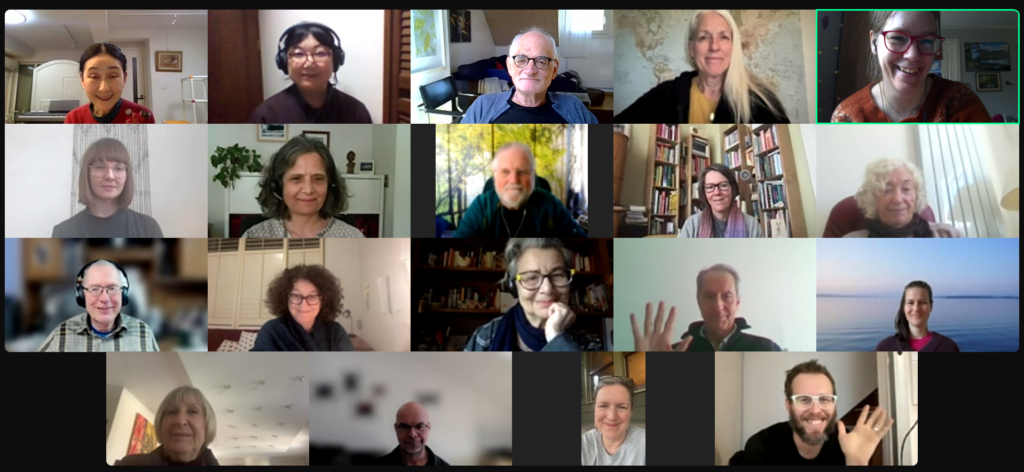
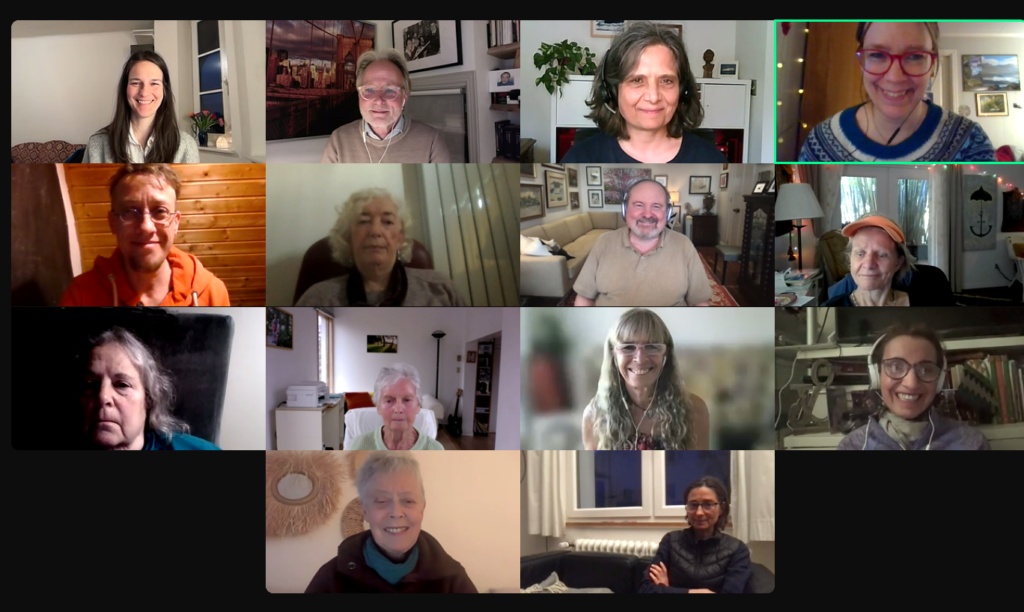
Monika Lindner & Frans Sandbergen – Exploring Multiple Edges in Your Thinking at the Edge Journey
If you take the steps of Thinking at the Edge to a meaningful edge of what cannot yet be said, then you embark on a journey of discovery that is as effective as it is vulnerable. Something new comes through the creative act of receiving.
In the process, you may encounter a variety of surprising and challenging thresholds, „broken“ edges, ridges and the like, which you had perhaps not expected nor anticipated, and which indeed seem as though they might lead you off the path. In such situations, it is helpful to take a step back, as it were, and adopt a meta level view. This view from the meta level can clarify the situation, and the way you are — and want to be — with your TAE topic.
This workshop offers such a meta-space for searching for traces of experiences, aspects, practices and qualities of what one can call a „reflective (self) care.“ Developing a culture of reflective (self) care supports the evolution of a process at the edge of what can be said, and then itself becomes nurtured by that very process.
March 2025
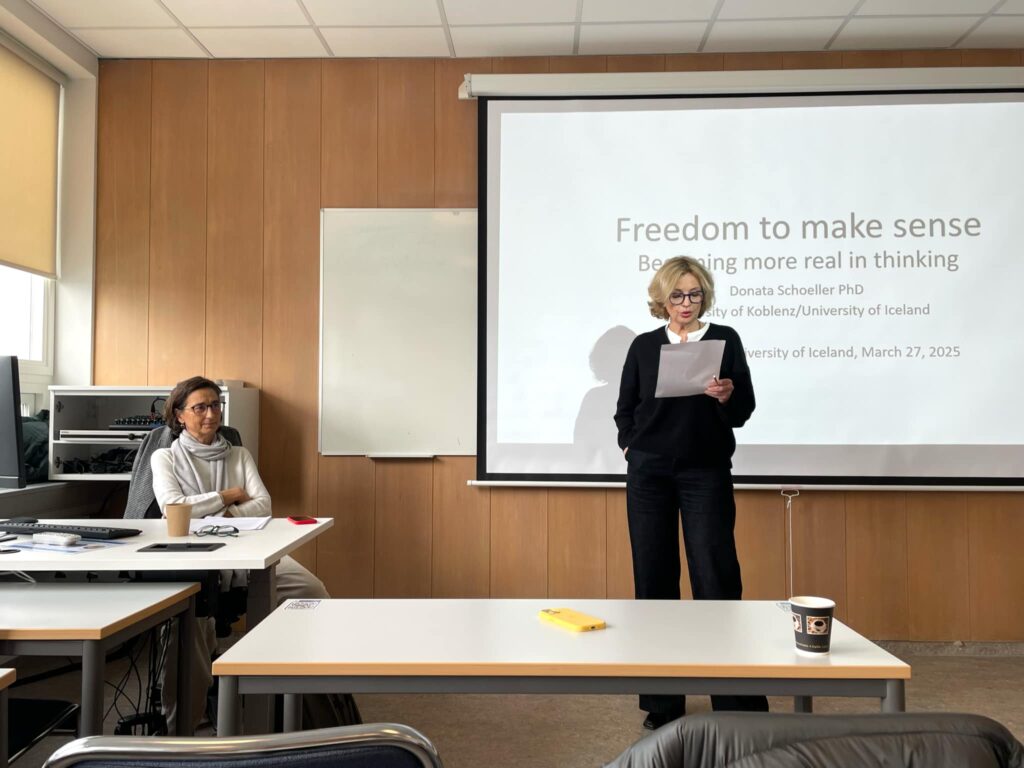
Freedom to make sense: Becoming more real in thinking
Lecture by Prof. Donata Schoeller at the Institute of Philosophy, Thursday March 27, in Árnagarður 311 at 15-16.30 GMT
Freedom to Make Sense: Thinking from the Felt Sense
Presentation at the University of Iceland, March 7th
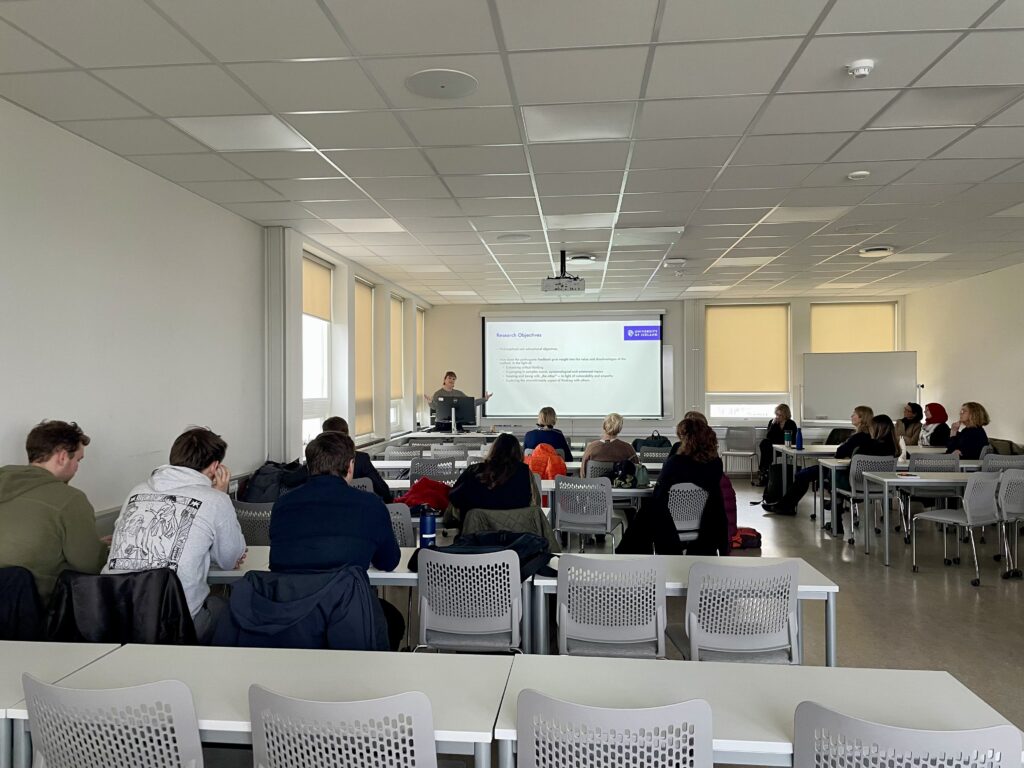
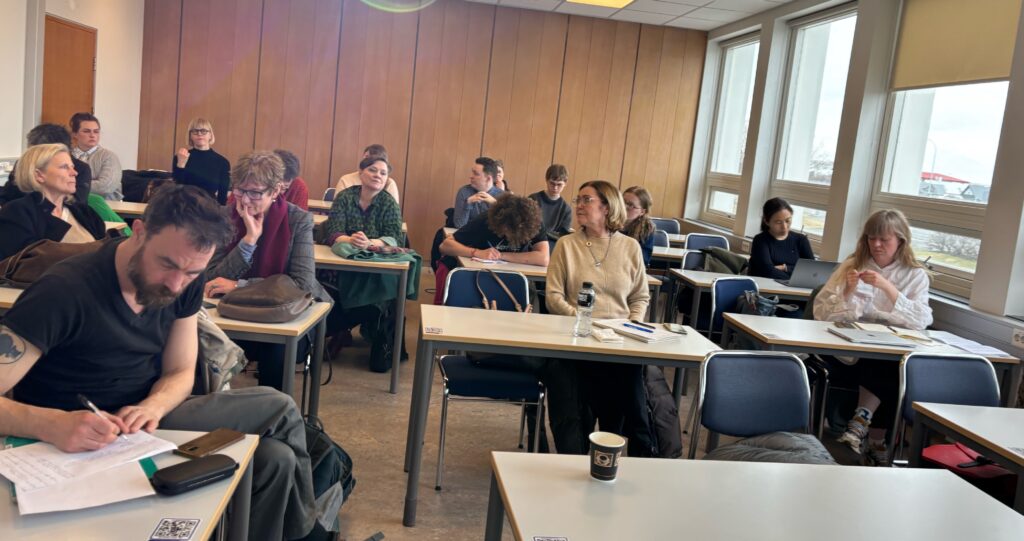
Participants in the excellence project „Freedom to Make Sense: Embodied, Experiential Research“ presented the theoretical foundations and methods of embodied critical thinking in learning and research. These methods aim to activate students’ and researchers’ own thinking by systematically utilizing their experiential knowledge. In other words, critical thinking is enhanced by engaging with subjects through one’s own felt sense of issues and fostering cognitive empathy in thought processes.
The seminar demonstrated how these methods are applied in teaching across various disciplines and with diverse groups. Finally, attendees had the opportunity to engage in felt-sensing exercises.
Photos are done by Chae Won Oh

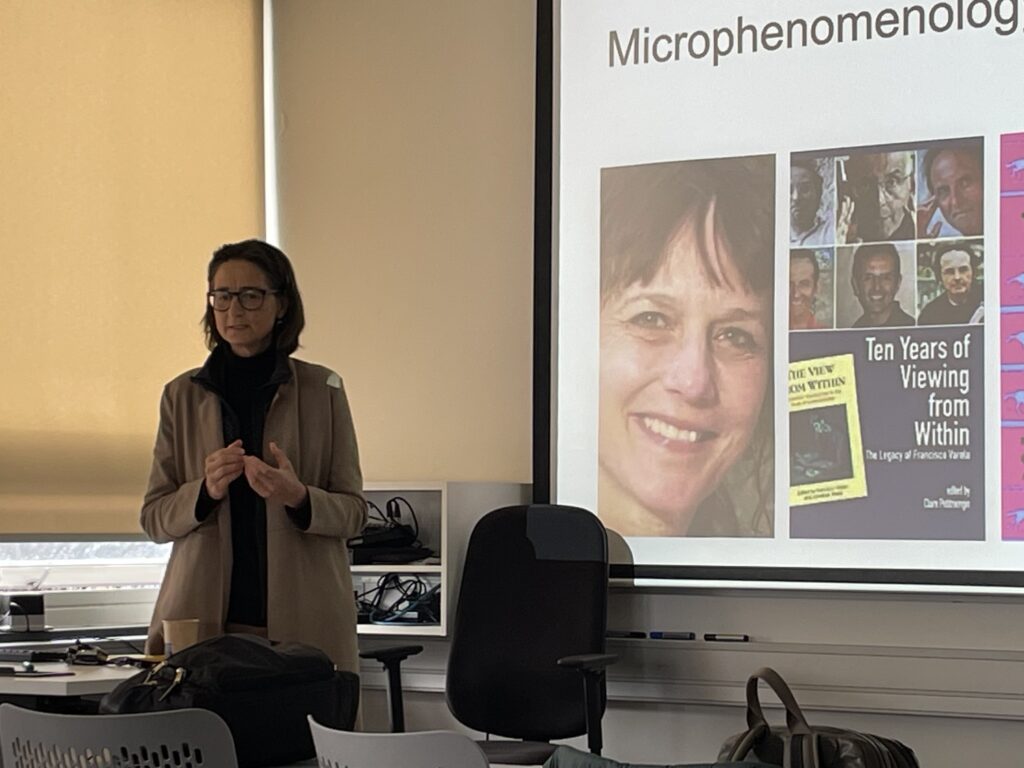
Guðbjörg R. Jóhannesdóttir, Gunndís Finnbogadóttir og Kristín Valsdóttir│Embodied Critical Thinking and Artistic Research
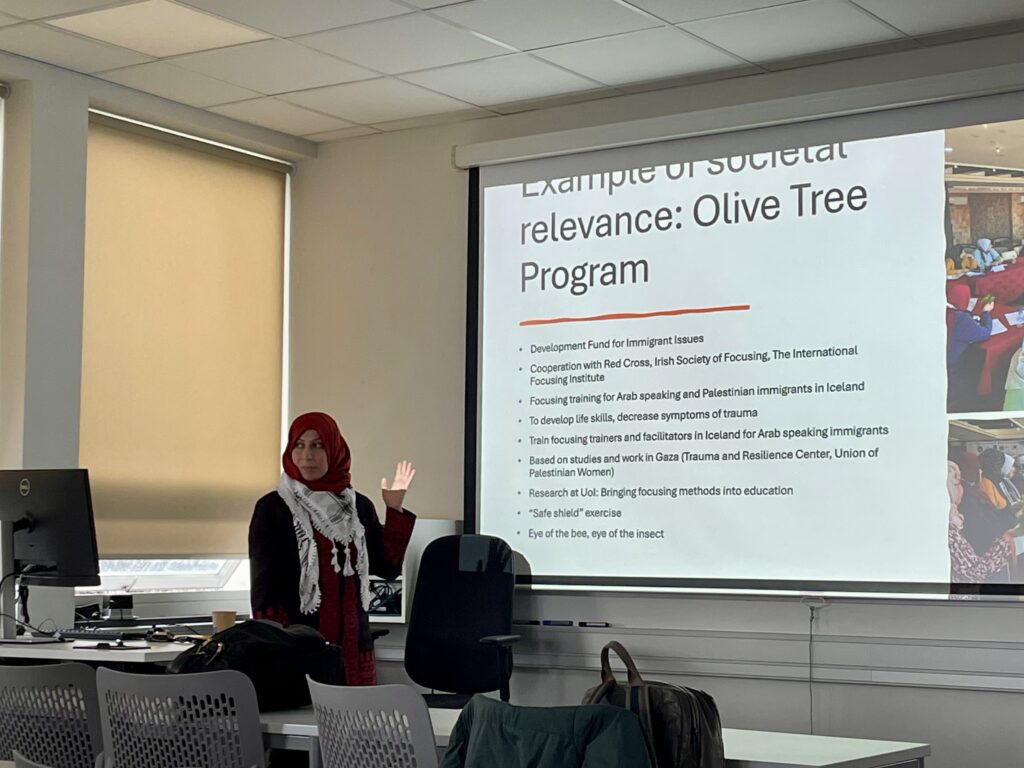
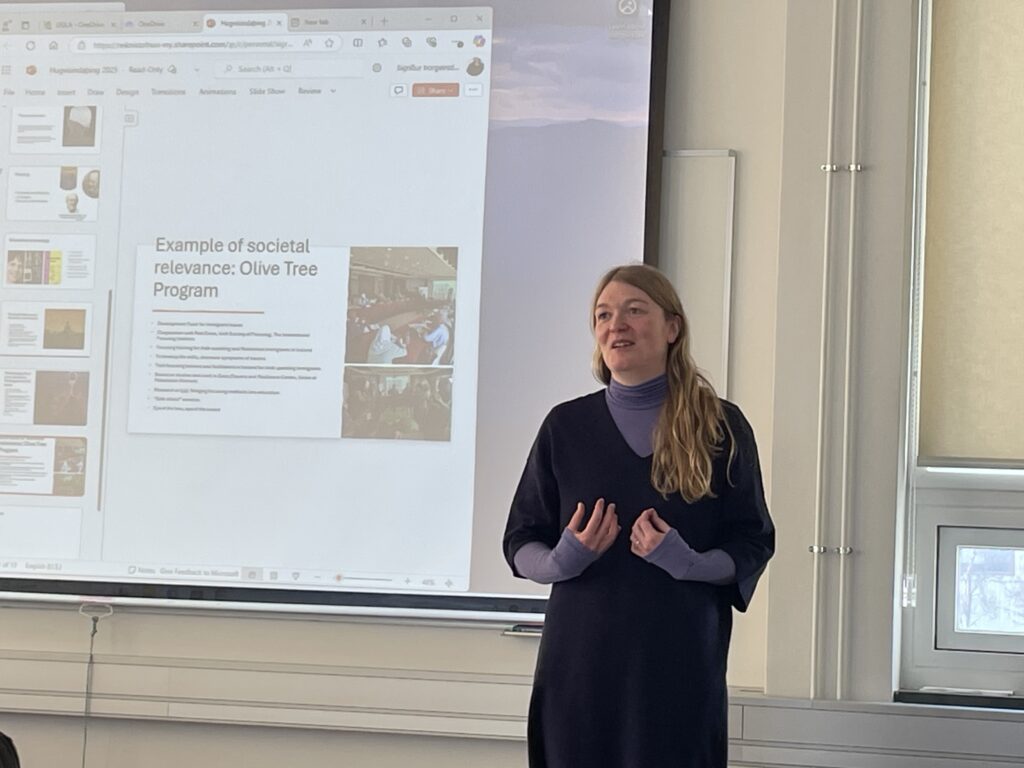
Donata Schoeller, Elsa Haraldsdóttir, Sigríður Þorgeirsdóttir and Ghada Radwan│Creating a Space for Embodied Philosophical Thinking in the University Classroom
We shared insights into how to create conditions for listening—both inner listening and felt sensing—along with trust and cognitive empathy in the classroom. This is based on our experiences in introductory courses as well as in research seminars. We discussed this in relation to the methodologies of Focusing and Thinking at the Edge.
November 2024
Exploring ECT and Freedom to Make Sense
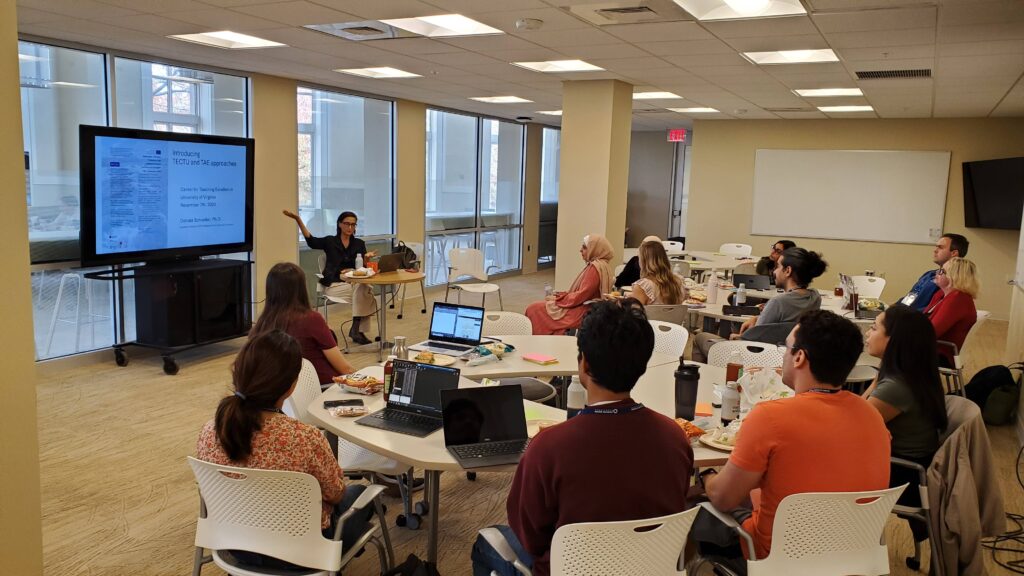
Prof. Schoeller’s workshops at University of Virginia
In November 2024, Donata Schoeller introduced the Embodied Critical Thinking and Freedom to Make Sense approaches in several workshops attended by an interdisciplinary group of graduate students and faculty members from the University of Virginia, as well as one introductory lecture at the the University of Toronto. She was invited by Professor Dorothe Bach, the Associate Director of the Center for Teaching Excellence at the University of Virginia, by Professor Michael Sheehey,Director of Research at the Contemplative Sciences Center at the University of Virginia, and Jeanne Watson, the former Associate Dean of Applied Psychology and Human Development at the University of Toronto.
„Embodied Critical Thinking and Understanding“ (ECTU)is an approach, research, and training initiative developed by a team of researchers at the University of Iceland. Over the years, it has evolved into a European Erasmus program and won an excellence grant for an international research project calles Freedom to Make Sense: Embodied, Experiential and Mindful research. The presentation will focus on some fundamental philosophical considerations underlying this approach.
ECTU acknowledges the complexity of lived and situated experience as the basis of human thinking, which always again needs processes of clarification and in-depth- understanding. This experiential characteristic of thinking calls for methods and practices that carefully open up a binding complexity, the intricacy of a point, of a crux, of a problem. Such understanding is not downloadable. Clarification and in-depth understanding often enough are the results of an unpredictable process. Acknowledging that human thinking always requires processes of clarification and realization harmonizes well with Kant’s three core questions of the Enlightenment: What can I know? What should I do? What may I hope? In a time of polarization, turmoil, and inflammable discourses, practices of embodied thinking and understanding strive to offer teachable and practicable methods to enhance listening skills and the capacity to handle complexity and vulnerability.
What participants say
Faculty members
„I deeply appreciated this workshop. It gave us permission to see “simple” things more completely and in ways that can guide understanding and shared reality. It gave us a process to think openly and listen carefully (with attention and care). It gave us time and space to be curious and creative. Thank you!“
„Today’s experience provided a long sought-for reminder for the things that matter in one’s interaction with the world, with one’s immediate surroundings and with oneself. It restored modes of listening that nowadays are almost extinct, and gave slowness and reflection a legitimate space within our daily experiences.“
“The process and experience today was very meaningful. It challenged me (in the most positive way) to apply it with my MBA students and be attentive to the individual pacing that the process requires. Thank you.”
„As someone that works with students this workshop was a great experience in listening without talking, and finding the root of felt self. Dropping the concept of my word and communicating what I was feeling with others with clarity was awesome. I felt more connected with the people I was talking to while also learning about myself.“
“What I found most productive (in an extremely thought-provoking workshop) was writing/thinking and the “background at my understanding of the concepts” I kind of can’t believe I haven’t yet done that with the key word of my book before! My concept was invention, and when I thought about it a flood of memories/ images made me realize how my personal relationship with this concept has really informed what I’m thinking about/ reacting to in my current research.
I would love to try this in my teaching because people are so rarely asked about their personal histories/experiences with concepts.They just go tot the academic information rather than the “felt-knowing”. The arguments, logic discourses. But felt-knowing can yield thinking that is so much richer and can deepen our understanding.Thank you! This was fantastic and so valuable to me.“
“Blocks and dead ideas arise in a culture of knowledge and thought that demands that every idea becomes a product. This is a tonic, a counterbalance, another way into and back to the reel of creativity.”
“This workshop and my conversation with my partner helped me see connections between concepts that didn’t seem related at first and made me realize (or remember) how playfully deep thought can be… what time given to process can make possible.”
“Hearing my thoughts reflected back to me was very moving. It was hard to listen without interfering. The cornerstone of this process appears to be the power of reflection, which I think translates to engineering well.
As an educator, I can use my alternate words to design lessons around the facets of this concept ( what I want to convey).”
„I appreciated being able to slow down and be in closer conversation with others. I also appreciated being able to share “unformed” thoughts in an academic environment. I would have loved to take a moment and feel into my body more. I was also inspired how I coils use this in my classroom- its; a little scary but useful! Thank you!“
„This was great! I leave a lot of workshops frustrated or disappointed because they don’t “give” me what I’m looking for. And while this workshop was not at all what I expected for something on critical thinking, it reminded me to slow down. It reminded me to be transparent with students. It reminded me to listen and give them space to listen to each other. And it taught me that not everything we do has to enact change. Conversations can inspire change, but change can be gradual, immediate or absent. And ultimately I think everything comes back to driving! Thanks for your time!“
Graduate students
“Embodiment in graduate research is critical. Empathy cannot coexist with guilt in design practice – architects and planners must cultivate a strong sense of self identity before going out to make change in the world.
Workshops like [this] are urgently relevant and invaluable spaces to slow down, intempt habits, and expand thinking. Please invite me to future workshops so I can continue to cultivate these skills! Thank you”
“It was a really rewarding experience. The aspects of self reflection and questioning the ideas and motivations behind concepts/research was really interesting. The openness of the space fostered thoughtful conversation and reflection.“
“Making your layers clear” really resonated as well. I saw how I could improve in how I articulate. The session made me aware of how to be a better listener and mindfully interact with logic and understanding. I would be interested in more sessions!“
“Yes! I was mentioning that the U.S. is a hassle and holding such events/space to just sit, think, understand, eat, is reviewed (culturally) unproductive. We’re all on a run, stressed, anxious, all the time because of it.
Thank you for the space, the food, the prompts, and maybe next time it can be together with a writing session (there goes my capitalistic impulse again) :,) “
“One main take-away from this event for me, as a physicist, is that even though we oftentimes feel overwhelmed with tasks to do or ideas to come up with in our pads, it’s important to think about the process itself of coming up with ideas and communicating them. Especially in physics, where these activities are strongly discouraged.“
„I believe this thought process stretches far beyond college campuses and higher education institutions I think the lack of listening and the concept that not every voice or thought should be considered valuable goes all the way up to our government and has seeped its way into our everyday society and is deeply embedded in our social norms and values ( even though we like to believe we are immune to implicit biases and are more “progressive” than ever before)“
“This workshop was really helpful in a conceptual way, but also in an affective, personal way. I not only see my concept differently, but I see my role in understanding this concept differently.”
June 2018
Embodied Critical Thinking (ECT)
Research Group since 2018
The Institute of Philosophy at the University of Iceland
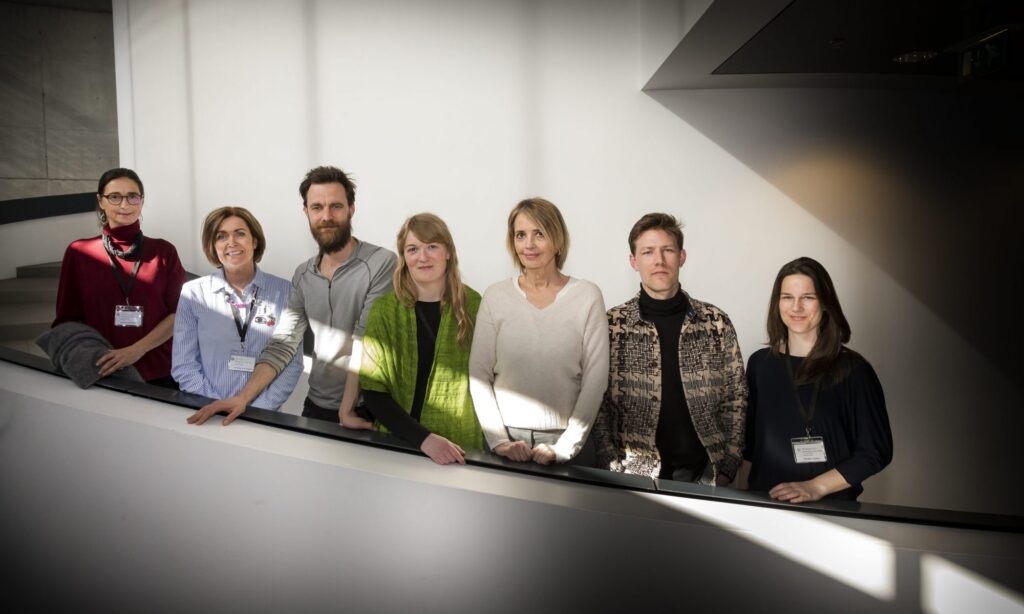
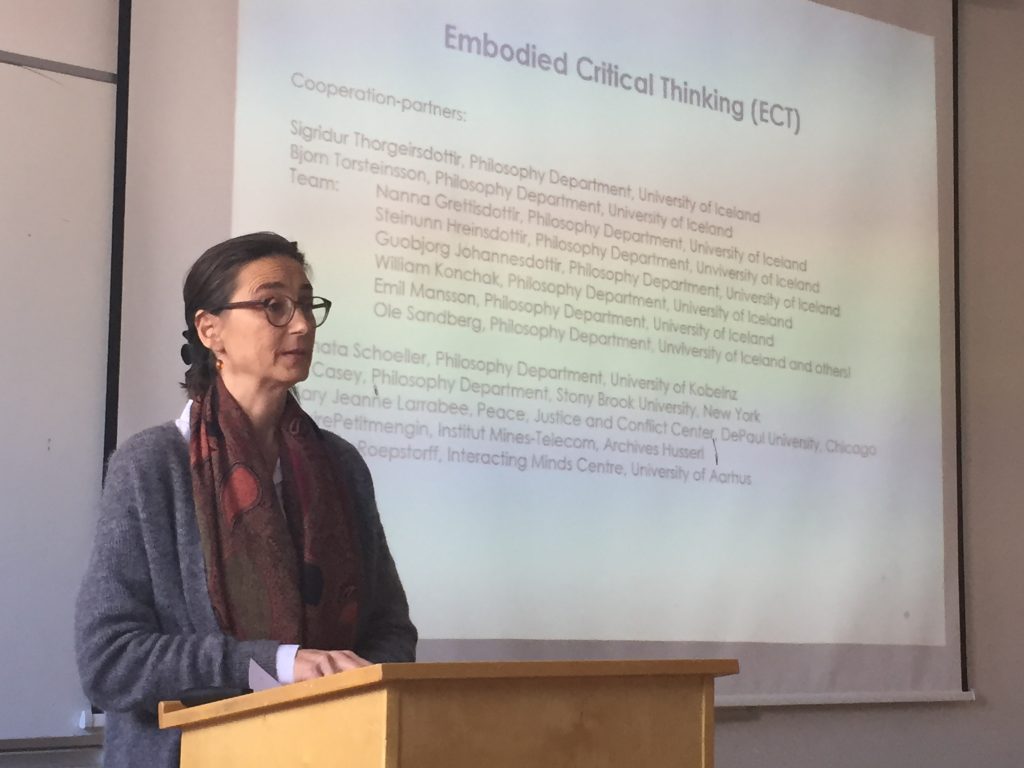
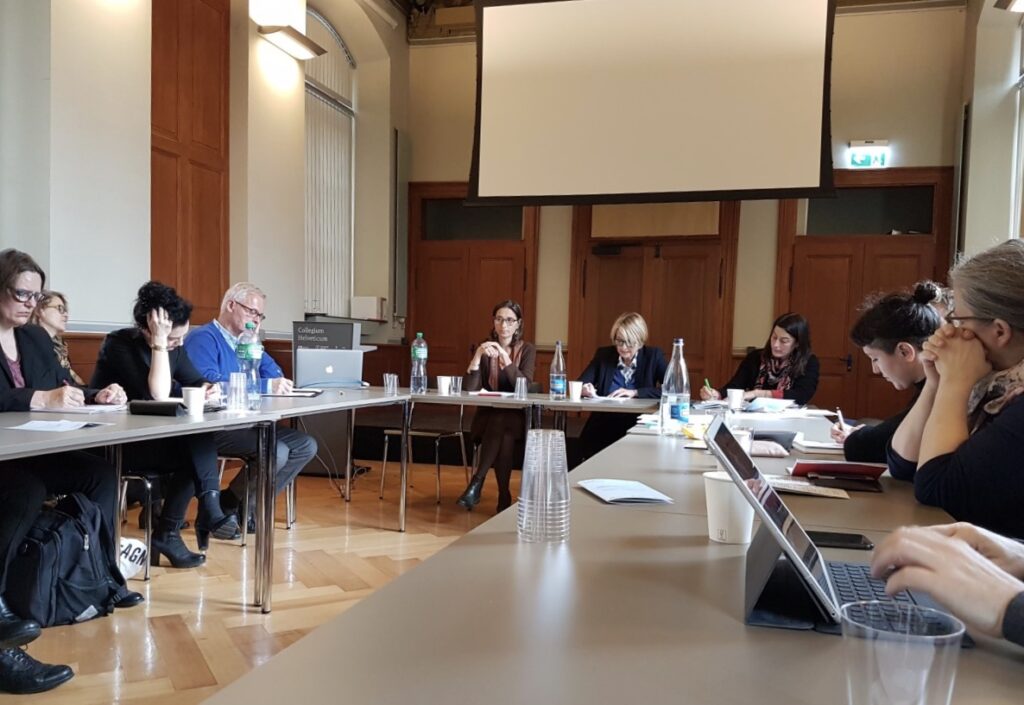
The ECT research group was established in 2018 by Prof. Sigríður Þorgeirsdóttir, Prof. Björn Þorsteinsson, Dr. Donata Schoeller and Dr. Guðbjörg R. Jóhannesdóttir. Ole Martin Sandberg, Steinunn Hreinsdóttir, Gústav Adolf Bergmann Sigurbjörnsson and Monika Lindner were also involved. It runs a monthly research lab and has offered numerous lectures, workshops and training sessions. Since then, further projects have developed from it, such as „Teaching Embodied Critical Thinking and Understanding“ (TECTU) and Freedom to Make Sense.
Its purpose is to rethink critical thinking in embodied form.
Critical thinking is the core ability to be trained in philosophy. Enlightenment, according to Immanuel Kant, implies the courage to think-for-oneself. How does philosophy teach that? Philosophy conveys rich contents, but does it convey rich methods to encourage students to face their very own questions/ideas evolving from their actual experience of a highly complex world ?
ECT researches how the embodied and entangled being-in-the-world is the ground from where we think critically.
ECT researchers explore (interact with) an embodied space of meaning, in which the fresh precision of experiential processes is as important and relevant for the philosophical discourse as arguments are.
ECT explores what this means in terms of what we think and how we think, in terms of academic practices as well as in terms of educational practices.
The aim of ECT is to undertake a systematic, thoroughgoing and practical reconsideration of the concept and practice of critical thinking by engaging recent theories and discussions of embodiment in terms of integrating the complexity of feeling and experiential backgrounds in thinking.
The theories and pedagogics of ECT were put to practice in teaching, tested and qualitatively assessed in seminars for students, and in workshops for teachers and researchers. International universities participate in the project, as well as two transdisciplinary research institutes in Århus and Chicago. Internationally leading researchers and transdisciplinary research centers in the field of embodiment are involved in contributing to the theoretical and practical components of the project. The project takes its inspiration from Eugene Gendlin’s “pioneering work” (Depraz, Varela and Vermersch 2002: 2) on how to deliberately engage embodied experiential and felt backgrounds in reflective, creative and research processes.
Contemporary philosophers have described various functions of tacit and implicit forms of knowing that expand our understanding of rationality, yet until recently there has been a truly inconvenient shortage of means to methodologically draw upon these more-than-conceptual forms of thinking. Research in the cognitive sciences confirms how engaging an intricacy implicit in feeling and lived experience expands the scope of frameworks which one has at hand, fostering the ability to think within complexity (Damasio 1994, 1999, Depraz, Varela and Vermersch 2002, Ratcliffe 2008, Petitmengin 2007, 2016, Petitmengin and Bitbol 2009).
Gendlin’s methodology of “Focusing” and the philosophical technique of “Thinking at the Edge” that he developed at the intersection of phenomenology, pragmatism and humanistic psychology, have been applied in teaching philosophy and in developing research projects in universities worldwide, but have not yet been systematically explored in relation to critical, problem-based transdisciplinary thinking abilities of students and researchers. The ECT research project is a first-time inquiry into the effects of these methodologies in view of an enhancement of critical thinking abilities on the basis of an evidence-based assessment.
ECT manifests the “experiential turn” in philosophical education, responding to the insight that cultivating thinking is not only about cognitive development and good grades, and critical discourse is not exclusively restricted to debating positions. The conception of the intellect as an analytical modality of detachment is complemented by an understanding of intellect as a modality of openness to the world in experience, which holds “only insofar as we know how to make contact with it” (Noe, 2012: 3) and thus emphasizes perceptual faculties no less than cognitive abilities. To foster creative and communal, but also independent and problemoriented thinking requires connecting with an experiential basis. Encouraging students to draw on and develop their ability to experience and feel complex situations in addition to their cognitive capacities (Dewey 1984, Gilligan 1993, Gendlin 2017, Ratcliffe 2008) enhances transparency in argumentation and leads to independent, yet engaged and problem-based thinking. ECT is an integrative methodology that teaches how to combine different kinds of logical precision with felt situational experience. This helps students tackle the real-life challenges of issues that matter in today’s paradoxical and complex world.